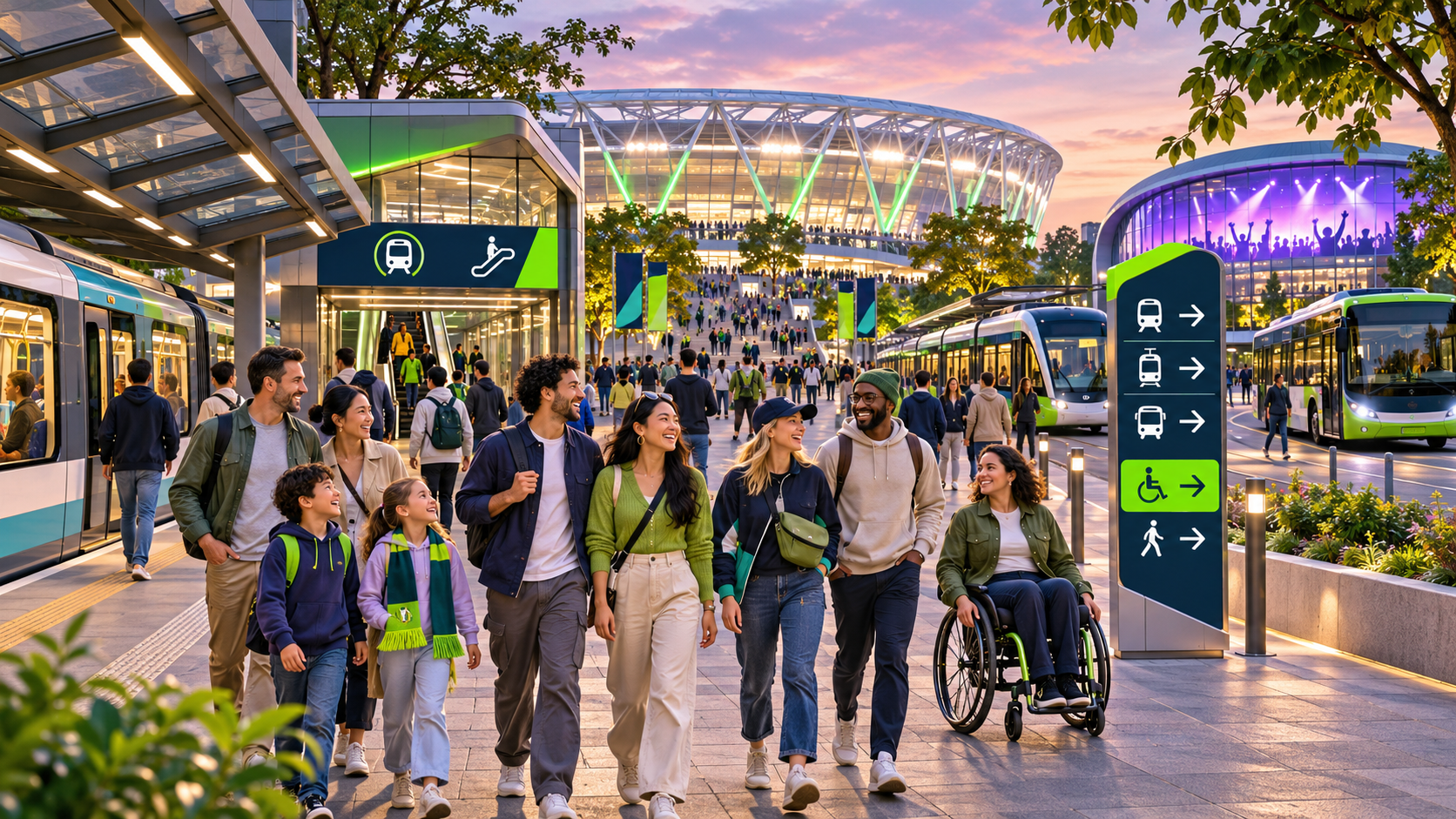
Quick answer: to use public transport for a major event, start with the transport operator's event page—not a normal weekday route alone. Confirm whether special services, station restrictions or included travel apply; plan the outbound and return trips separately; arrive before the heaviest crowd; and save an alternative station or route. Check live alerts again before leaving the venue.
Concerts, sports matches, festivals and parades can change how a network operates. Trains may run more often, buses may divert, the closest station may become exit-only, and thousands of people may leave at once. A good event trip plan accounts for those temporary rules instead of assuming an ordinary journey.
1. Find the official event transport plan
Search the event name on the official transit operator's website, then check the venue's official travel page. Major operators often publish event-specific information with the recommended station, extra service, temporary stops, fare rules and post-event arrangements. Transport for NSW maintains a dedicated event directory; LA Metro lists major venues and notes that some receive special event-day service; Auckland Transport publishes whether travel is included or standard fares apply.
Read the notice for the correct date and session. A multi-day festival may use different service patterns each day. A stadium may host two events with different finishing times. Save the official page and take a screenshot for reference, but refresh it on the day because operational details can change.
If there is no event page, use the operator's journey planner, planned-work page and service-alert feed together. Our step-by-step public transport planning guide explains how to verify stops, directions and transfers.
2. Check whether the event ticket includes transport
Never assume admission includes the ride. Arrangements vary by event even at the same venue. Auckland Transport's listings, for example, distinguish events with included bus and train travel from events where standard fares apply. Transport for NSW likewise tells riders when public transport is included and when an Opal card or contactless payment is still required.
When travel is included, confirm:
- which modes and geographic zones are covered;
- the valid start and end times;
- whether the mobile or printed event ticket must be shown;
- whether you still need to tap at gates; and
- whether airport, premium, reservation or regional services are excluded.
If standard fares apply, prepare the accepted card, app or ticket before joining the crowd. Top up early and use the same payment method throughout if the network requires it for transfer or fare-cap calculations. See our guide to paying for public transport abroad when attending an event in an unfamiliar city.
3. Match the route to the correct venue entrance
A venue name is not precise enough. Large stadiums, fairgrounds and festival sites can span several blocks, and different ticket sections may use different gates. Put the assigned entrance—not just the venue center—into the plan. Check the official pedestrian map, accessible entrance and any security perimeter.
The geographically closest station is not always the recommended one. Another station may have wider platforms, more frequent service, step-free access or a safer pedestrian route. Authorities may direct crowds away from the closest entrance or designate separate arrival and departure stations. Follow event-day signs and staff even if a general navigation app suggests a shorter path.
Review the final walk in daylight or on a map. Identify major crossings, bridges, underpasses and the return station entrance. Do not cross tracks, barriers, bus lanes or closed roads to shorten the route.
4. Choose an arrival window, not an exact train
Plan to reach the venue area with enough time for the walk, ticket check, security screening and a service delay. The target is an arrival window, not a single perfect connection. An earlier service gives you options if a vehicle is full or a platform is temporarily controlled.
Avoid arriving at the same moment as the largest crowd when possible. Doors opening, first performance and kickoff are predictable demand peaks. Transport for London advises leaving extra time when major works or events affect travel. LA Metro's rider guidance similarly recommends planning in advance and arriving early.
Do not overcorrect by arriving before the venue area is open or staffed. Check gate times and local conditions. For weekday events, ordinary commuters may overlap with the event surge; our rush-hour transit guide covers boarding and positioning in crowded vehicles.
5. Save the outbound and return trips separately
A route that works before the event may not work afterward. Service frequency drops later, bus stops move, and the station used for arrival may have post-event access controls. Save two plans:
- Outbound: origin to the correct entrance, with an early alternative.
- Return: the designated departure station or stop to the final destination, with the last useful connection highlighted.
Write down route names, directions and transfer stations so the plan does not depend on mobile data. If the return involves several modes, verify the final leg first. A frequent stadium shuttle is not helpful if it arrives after the last regional train.
For late finishes, use our late-night public transport checklist. If the journey includes rail connections, protect them with the guidance in how much time to leave between trains.
6. Confirm the last service and realistic event finish
Published event times can slip because of overtime, encores, weather, ceremonies or crowd release. Find the scheduled finish and the last three useful departures—not only the final one. Note the walking time from your seat or area to the platform after security and crowd controls.
Ask four questions:
- Does special service continue after the event?
- Is the last departure a normal timetable service or an announced extra?
- Will a late first leg still connect to the final bus or train?
- What safe option exists if the event runs long?
Do not rely on an unofficial promise that vehicles will wait. If the margin is small, leave earlier, choose a route with later service, arrange a verified alternative or stay closer to the venue.
7. Look for temporary stations, closures and reroutes
Events change streets as well as timetables. Parades and security zones can divert buses, relocate stops and close station entrances. WMATA warns that major events can cause detours, route adjustments and stop relocations. CTA's alert system includes temporary changes caused by events, and Transport for London publishes major works and event impacts.
Open each alert and check the direction, time and exact stop. A bus may serve the venue normally before the event but use a temporary stop afterward. A station can remain open while one entrance or lift is unavailable. The operator's event page should take priority over an old saved itinerary.
If track work and an event occur together, allow a larger buffer. Replacement buses have limited capacity and use roads affected by the same crowd.
8. Move through event crowds safely
After the event, expect controlled queues, temporary barriers and short pauses at station entrances. These measures prevent too many people reaching a platform at once. Join the marked queue, keep entrances clear and follow staff directions. Pushing forward rarely gets a traveler onto an earlier train and can create risk.
- Let passengers exit before boarding.
- Keep bags close and off empty seats.
- Stand behind platform markings.
- Do not stop at the top of stairs, escalators or fare gates.
- Wait for the next vehicle if staff say the current one is full.
- Report unsafe behavior or a medical issue to staff immediately.
Keep your phone secure and look up while walking. Use the principles in our public transport safety guide, especially in unfamiliar stations and at night.
9. Give every group member the plan
A group can be separated at gates, on a full vehicle or when mobile networks are congested. Share the route, destination address, ticket details and one meeting point outside the busiest flow. Children should know which adult to stay with and what to do if separated.
Choose a specific meeting place such as a staffed entrance or numbered gate—not “outside the station.” Avoid gathering immediately beyond fare gates or platform stairs. If one person misses a train, the rest of the group should know whether to wait at the next station or continue to the final meeting point.
For families, review how to use public transport with children. Large groups should not hold doors or force everyone into one vehicle; split deliberately and assign an adult leader to each smaller group.
10. Verify accessibility for the event-day pattern
Ordinary accessibility information may not capture event-day restrictions. Check lift status, step-free entrances, temporary stops, boarding assistance, accessible pedestrian routes and the venue's accessible gate. A station that is normally suitable may use a different exit flow after a match.
Contact the operator or venue in advance when assistance is required. Confirm whether booked assistance covers additional services and whether mobility devices can use event shuttles. CTA provides elevator alerts alongside service status, while many official planners allow accessible-route filters.
Allow more time, but do not accept an unsafe improvised path. Ask staff for the designated alternative. Our accessible public transport planning guide provides a leg-by-leg checklist.
11. Travel light and check venue bag rules
A bag allowed on transit may be refused by the venue. Check size, prohibited items and storage rules before leaving. Returning to a distant locker or hotel can make you miss the event or the last service.
Carry only what you can control in a crowded vehicle. Keep aisles, doors and wheelchair spaces clear. Secure loose items before boarding and avoid blocking another rider with event merchandise. For larger items, see how to travel on public transport with luggage.
Bring a charged phone and compact power bank, but also keep the destination and return route offline. Water and weather protection may be useful, subject to the venue's entry rules.
12. Build a backup that avoids the same bottleneck
A useful backup should not depend on the same closed road, platform or final connection. Options may include:
- a second station on another line;
- a longer walk to a less crowded corridor;
- a regular bus instead of the event shuttle;
- leaving before the final crowd or waiting in a safe open venue area;
- traveling to a different interchange before transferring; or
- a verified taxi, ride-hail pickup zone or prearranged ride.
Check whether the backup still runs late enough and is accessible to everyone in the group. Do not use an isolated walking route merely to avoid a queue. If service changes after departure, follow our guide to handling public transport disruption.
13. Recheck live information at three moments
Check the official operator:
- on the morning of the event for planned changes;
- before leaving for live delays and entrance updates; and
- before exiting the venue for the return pattern.
Auckland Transport advises checking live departures, line status and journey-planner alerts because events and other conditions can change service at short notice. CTA offers route alerts and accessibility updates. General map apps are useful, but the operator controls the temporary service plan.
Distinguish a scheduled time from a live prediction. The difference is explained in our guide to scheduled versus real-time transit arrivals.
Major-event public transport checklist
- Official operator event page checked
- Correct date, venue entrance and ticket session confirmed
- Included travel or standard fare verified
- Fare media ready before departure
- Outbound and return routes saved separately
- Last three useful departures noted
- Station restrictions, bus reroutes and track work checked
- Accessible route and lift status verified
- Group meeting point agreed
- Venue bag rules checked
- Independent backup route saved
- Phone charged and key details available offline
- Live service checked before leaving the venue
Frequently asked questions
Is public transport free with a concert or sports ticket?
Sometimes, but not automatically. Check the official event transport page for the covered modes, time window and proof required. Other events at the same venue may use standard fares.
How early should I arrive by public transport?
Work backward from the venue's recommended entry time and add the final walk, security screening and a service-delay buffer. Choose an arrival window with at least one earlier usable service.
Will extra trains or buses run after the event?
Only rely on extra service when the operator officially announces it. Confirm the route, departure location and connection to your final leg.
Why is the closest station not always recommended?
A different station may have greater capacity, step-free access, more frequent service or a safer crowd route. Event-day operations may also make the closest station exit-only or temporarily restricted.
What should I do if I miss the last service?
Stay in a safe, staffed or well-lit place, check the operator's official alternatives and use a verified pickup point if arranging another ride. Do not follow an unsafe walking route or an unverified offer.
The practical takeaway
Using public transport for a major event is easiest when you plan around the temporary operating plan, not the ordinary timetable. Confirm fare rules, match the route to the correct gate, protect the return journey and expect managed queues. With official live information, an independent backup and a clear group plan, the trip can remain calm even when the network is carrying its biggest crowd of the day.
Official sources and further reading
- Transport for London: major works and events
- Transport for NSW: getting to events
- Transport for NSW: trip planning and alerts
- LA Metro: stadiums, venues and event travel
- LA Metro: rider guide
- TransLink Vancouver: events
- Auckland Transport: travel to major events
- Auckland Transport: check before you travel
- Chicago Transit Authority: system status and alerts
- Chicago Transit Authority: route and accessibility updates
- WMATA: major-event bus detours