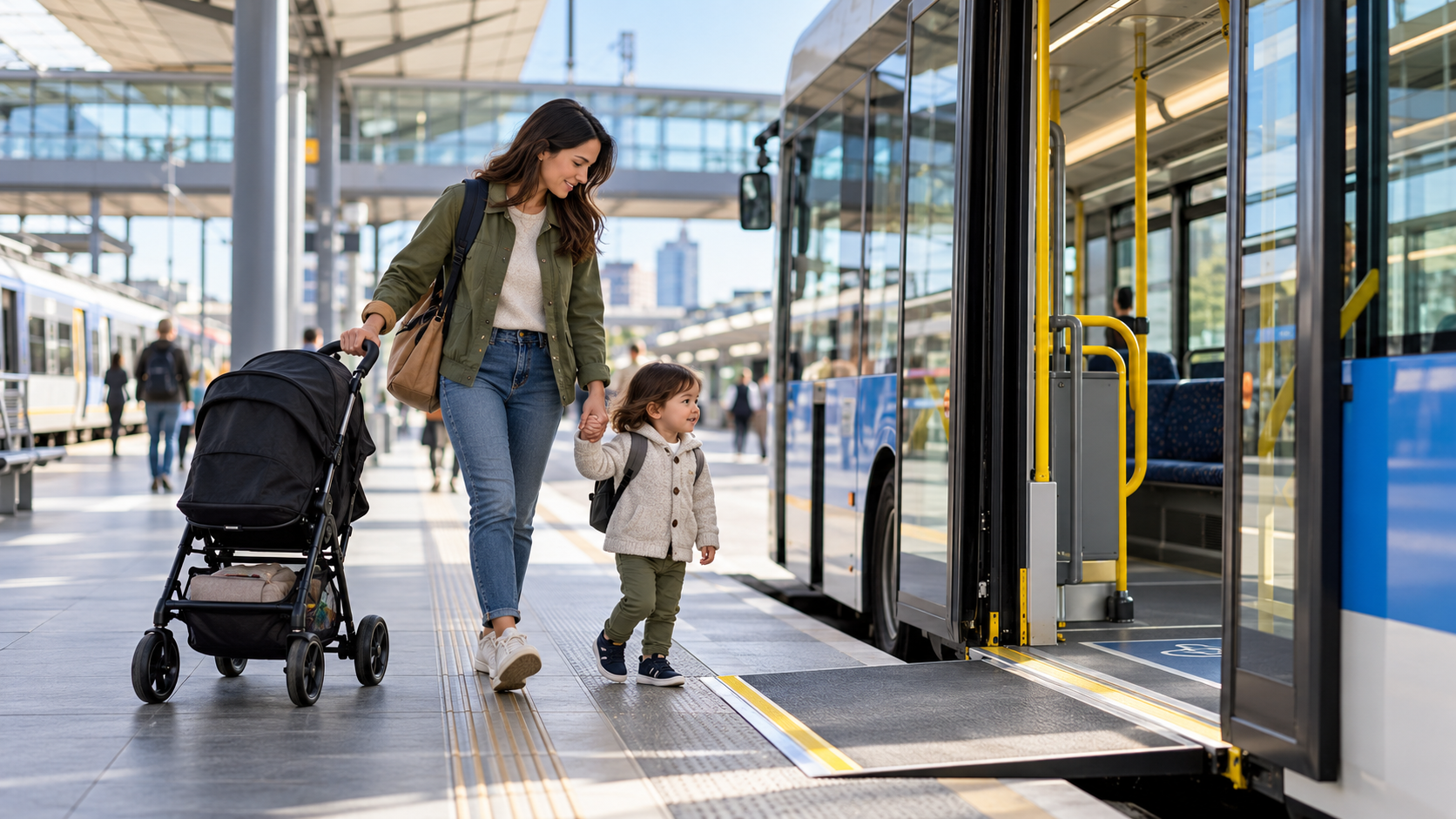
Quick answer: using public transport with children is easier when you choose a low-barrier route, check child fares and stroller rules, allow extra time, and decide how everyone will board, transfer and reunite if separated. Keep tickets and essentials within one-hand reach, use lifts or level boarding where available, secure the stroller, and follow the operator’s current instructions.
There is no universal family-transit rule. A stroller may remain open on one bus but need to be folded on another. Children may travel free until different ages, and proof-of-age rules can vary even within one country. Use this guide as a worldwide planning framework, then confirm the details with the official operator for every part of your trip.
1. Check child fares and family rules before leaving
Start with the operator’s official fare page, not a travel forum or an old screenshot. Record the age band for free or discounted travel, whether the child needs a ticket, and whether proof of age is required. Check each operator separately if a journey combines a city bus, regional train and airport service.
Look for answers to these questions:
- At what age does a child need a ticket?
- Must a child use a separate smartcard or tap?
- Does a free child still need a reservation on a long-distance train?
- Are family, off-peak or group tickets cheaper than individual fares?
- Is a stroller carried free, treated as luggage or subject to size limits?
Lisbon Metro, for example, directs passengers with baby strollers through wider gates, while Denmark’s national public-transport information publishes specific child age bands and accompaniment rules. These are useful examples of why the practical details must be checked locally. If payment is unfamiliar, review our guide to paying for public transport abroad.
2. Choose the easiest route, not only the fastest
The journey planner’s fastest result may include stairs, a long interchange, a two-minute transfer or three vehicle changes. With a child, the more dependable route is often the one with fewer transfers and simpler boarding.
Compare routes using family-specific criteria:
- step-free entrances, working lifts and level boarding;
- fewer transfers and shorter walks inside stations;
- longer but realistic connection times;
- toilets or baby-care facilities on longer trips;
- sheltered stops and places to wait away from traffic; and
- a backup service if the first option is full or disrupted.
Singapore’s Land Transport Authority highlights family-friendly facilities such as nursing rooms and barrier-free access, but availability varies by station. Treat any facility as confirmed only when it appears in current official information. Our accessible journey planning guide explains how to verify lifts, platform gaps and assistance.
3. Decide whether a stroller, carrier or both fits the trip
A stroller helps on long walks and gives a tired child a familiar seat, but it also adds weight and can be difficult on stairs or crowded vehicles. A carrier keeps your hands freer and takes less space, but may be uncomfortable for a long journey or unsuitable for a particular child or caregiver.
If you bring a stroller, a lightweight model that folds quickly is usually easier. Practice folding it before the trip. Remove loose bags that could fall, keep the brake working and avoid hanging heavy items from the handles. Do not assume that an open stroller is guaranteed a space.
Policies differ by mode and fleet. GO Transit welcomes strollers but says they must be folded and stored on high-floor highway buses. Transport for NSW and Tokyo’s Toei Transportation explain how open strollers should be secured and note that passengers may need to fold them or wait when space is unavailable. Check the exact vehicle type where possible.
4. Pack for one-handed access
During boarding, you may be holding a child, stroller or handrail. Put the most-used items where one hand can reach them:
- tickets, fare card and identification;
- phone, charging cable and compact power bank;
- water and a small snack where eating is permitted;
- wipes, tissues and one simple change of clothes;
- essential medicine in its proper packaging;
- a quiet, compact activity; and
- the destination address in the local language.
Avoid filling every available bag. Each extra item must be carried through gates, lifts and transfers. Put a name and contact number inside a bag or stroller rather than displaying personal details prominently.
5. Give every adult and child a simple travel plan
Before entering the system, tell children what will happen in short steps: “We tap the card, take the lift, wait behind the line, then board the train.” Give adults clear roles. One adult can manage the child while another handles tickets and luggage; do not both assume the other person has the child.
Teach an age-appropriate separation plan. A child who becomes separated should stop, stay in a safe public place, and approach uniformed staff or another agreed helper. Older children should know the destination, caregiver’s phone number and what the local staff uniform or help point looks like. Do not ask a young child to navigate through the network alone to find you.
6. Use safer habits at stops and platforms
Hold a young child’s hand or keep them securely in the stroller well before the vehicle arrives. Stay behind platform markings and away from the curb. Apply the stroller brake and position it parallel to the platform edge where the operator recommends it; never leave it unattended.
Transport for London advises travelers with a buggy to ask staff for help and use a lift rather than an escalator when possible. Transport for NSW advises keeping prams behind safety lines and using lifts or ramps. Follow posted local instructions when they differ.
Stand where you can see the route number and destination without moving toward the edge. If the stop is busy, wait farther back until the correct vehicle is approaching.
7. Board and exit without rushing
- Confirm the route and destination before approaching.
- Let passengers exit first.
- Keep the child next to you, not between the vehicle and stroller.
- Use the accessible door, boarding ramp or staff assistance when needed.
- Move clear of the doorway and secure the stroller or fold it as instructed.
- Prepare for the stop before arrival, but do not release the brake too early.
If the doors begin closing, wait for the next service. A missed vehicle is inconvenient; splitting the group or trapping a stroller is dangerous. On a train, all members of the group should use the same door unless staff direct otherwise.
8. Handle buses and shared spaces carefully
Low-floor buses may kneel or deploy a ramp. Signal the driver if you need time, but remain clear while equipment moves. Place an open stroller in the designated area, apply its brake and use any restraint the operator provides. Keep hold of it throughout the journey.
Space is shared. A wheelchair user may have priority, and a driver may ask you to fold the stroller, move or wait for another bus. Singapore’s LTA permits open strollers within published dimensions in designated spaces and instructs caregivers to use the restraint and brakes. Toei similarly says a stroller may need to be folded when two stroller spaces are occupied or when conditions require it.
If you cannot fold the stroller while safely holding the child, ask the driver what to do. Never block the aisle, emergency exit or doors.
9. Make rail and metro travel simpler
Use a wide gate when provided, and keep the child and stroller together as you pass through. A gate can close between family members if each person hesitates. At the platform, check the train’s final destination and stopping pattern before boarding.
Choose a carriage near a lift at the destination if the operator’s station map shows where to board. On long-distance rail, verify whether seats are reserved, whether a stroller has to be stored, and whether a child needs a reservation even when the fare is free. Our guide to public transport with luggage can help reduce what you carry.
10. Build generous transfer time
A connection that is comfortable for one adult may be unrealistic with a child, stroller, lift and toilet stop. Add time for leaving the first vehicle, finding the correct lift, crossing a large station and boarding calmly. Avoid relying on the last possible connection.
For an important train or flight connection, calculate the consequence of missing it. Our guide to train connection time explains how station layout, separate tickets and assistance affect the buffer.
At each transfer, count people and bags before moving. If adults split tasks, agree on a meeting point that is specific—such as the staffed information desk—rather than “near the entrance.”
11. Adjust early for crowds and disruptions
Travel outside peak periods when the schedule allows. Crowding makes it harder to keep the group together and may remove available stroller space. For major events, allow for queues and temporary station controls.
Check official alerts before departure and during a long trip. If a lift fails or a replacement bus cannot take the stroller, replan before reaching the blocked point. Use our public transport disruption checklist to compare waiting, rerouting and turning back.
Keep one realistic backup: an earlier service, a parallel accessible route, a staffed place to wait or a verified pickup point. The backup must work with the child, stroller and luggage you actually have.
12. Recheck the details for long-distance travel
Regional coaches and intercity trains can have different rules from urban transit. Confirm seat reservations, child restraints, luggage allowances, stroller storage, toilets, food rules and whether boarding assistance must be booked. Transport for NSW’s long-distance family guidance, for example, recommends booking ahead and planning the child’s needs for the complete journey.
Do not assume a connection between two operators is protected. Save booking references offline, know where oversized items are collected and allow time to retrieve a stored stroller before the next leg.
Family public transport checklist
- Child fare, ticket and proof-of-age rules checked
- Stroller policy confirmed for each operator
- Low-barrier route and working lifts verified
- Transfer and toilet time added
- Tickets and essentials reachable with one hand
- Adult roles and child separation plan agreed
- Stroller brake, folding method and restraints checked
- Official alerts reviewed
- Backup route or pickup point prepared
Frequently asked questions
Are strollers allowed on public transport?
Often, but the rules depend on the operator and vehicle. An open stroller may be permitted in a shared space, while another service may require it to be folded or stored.
Do children travel free?
Sometimes. Free-travel ages, required tickets, reservations and proof-of-age rules vary. Check every operator on a multi-operator journey.
Must I fold the stroller on a bus or train?
It depends on local policy, available space and the vehicle. Be ready to follow the driver or staff instruction, and never block a wheelchair area, aisle or exit.
What is the best public transport route with children?
Usually the route with fewer transfers, working lifts, realistic connection time and a simple backup—even if it takes slightly longer than the fastest result.
What should a child do if separated?
Use a plan practiced before travel: stop, remain in a safe public place and approach uniformed staff or an agreed helper. The child should know a caregiver’s contact number when age appropriate.
The practical takeaway
A smooth family journey is less about carrying everything and more about removing fragile steps. Confirm the rules, choose a low-barrier route, leave time to board without rushing and give everyone a simple plan. Official operator guidance and staff instructions always take priority over general advice.
Official sources and further reading
- Transport for NSW: travelling with prams and young children
- Toei Transportation: using buses with a baby stroller
- Transport for London: staying safe while you travel
- Singapore LTA: parents on public transport
- Singapore LTA: an inclusive public transport system
- Lisbon Metro: using the metro
- GO Transit: travelling with a stroller
- Chicago Transit Authority: tips for parents with children
- Public Transport Denmark: child ticket rules
- Transport for NSW: long-distance travel with children