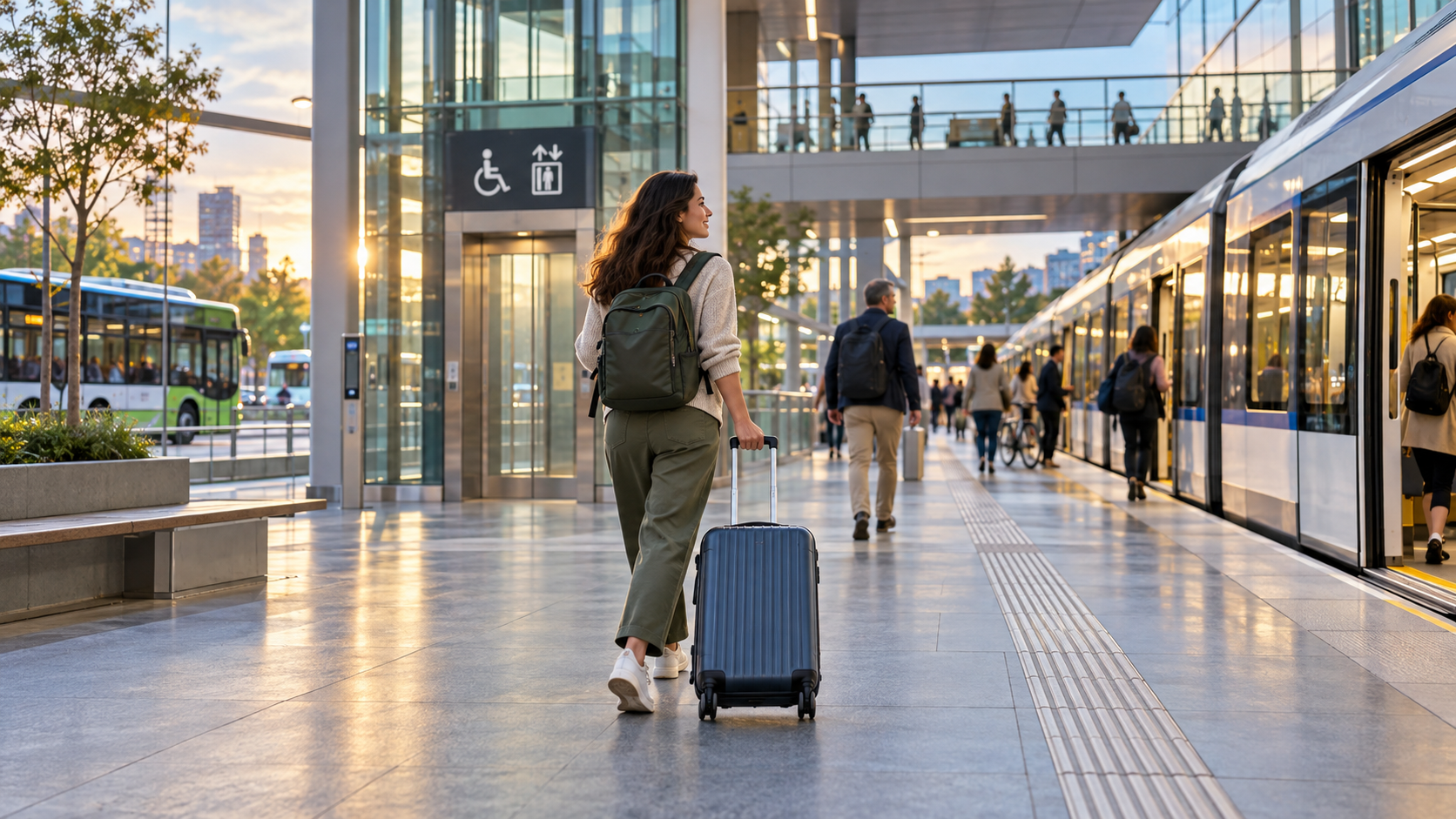
Quick answer: you can usually travel on public transport with ordinary luggage, but the rules and available space differ by operator, vehicle and route. Before leaving, check the strictest luggage policy on your itinerary, confirm that you can lift or roll every bag yourself, choose step-free stations where possible and leave extra time for boarding and transfers. On board, use the designated rack, the space under your seat or another permitted storage area—never a doorway, aisle, priority area or empty seat needed by another passenger.
The difficult part is rarely the long ride. It is the chain of small movements around it: reaching the correct entrance, getting through a gate, using a lift, finding the right carriage and changing platforms without losing control of a suitcase. A route that looks fastest on a map may be a poor choice if it includes stairs, a rushed transfer or a bus with limited storage.
This guide is designed for public transport worldwide. It does not assume that every metro, bus or railway uses the same rules. Examples from official operators show why checking your exact service matters, while the planning method works across cities and countries.
1. Check the rules for every operator and vehicle
Start with the operator’s official luggage or conditions-of-carriage page. Search for your specific train, coach, metro or bus company—not just the city name. Look for limits on the number, dimensions and weight of bags; whether you must reserve storage; whether checked baggage exists; and whether special items have separate rules.
Policies vary widely. Amtrak publishes item, size and weight limits for carry-on baggage and says passengers must be able to lift carry-ons safely. Britain’s National Rail says passengers are generally welcome to bring up to three pieces but warns that individual train companies may set different policies. JR East publishes its own size, weight and quantity limits, while Transport for NSW applies different allowances to regional trains and coaches. These are examples, not universal permissions.
For a journey involving several operators, follow the strictest rule for the relevant leg. A suitcase accepted on an intercity train may be awkward or refused on a replacement coach, small shuttle or local minibus. Transport for NSW, for example, says the coach allowance applies to an itinerary that combines one of its coaches and trains.
Treat special items separately
A bicycle, surfboard, musical instrument, stroller, mobility aid or battery-powered device may not count as ordinary luggage. It can require a reservation, protective bag, separate ticket or specific carriage. Firearms, fuels, compressed gases and other hazardous items are commonly restricted. Read the operator’s dedicated page and do not assume an airline rule carries over to rail or local transit.
2. Use the manage-it-yourself test
A practical global rule is to bring only what you can control without blocking other people. Before the trip, test whether you can:
- lift the bag onto a rack without twisting or losing balance;
- roll or carry it through a gate while holding your ticket or phone;
- move it over a small gap or step;
- stop it rolling on a moving vehicle;
- keep one hand free for a rail; and
- move all items in one trip rather than leaving one unattended.
TfL’s conditions permit luggage that a passenger can carry, including on stairs and escalators, while retaining staff discretion over items that obstruct or endanger others. Deutsche Bahn similarly expects passengers to stow their own luggage and recommends keeping valuable or essential items such as medicines, keys and laptops in hand luggage.
If the test fails, reduce the load, use a smaller bag, book assistance where eligible, arrange delivery or choose a service with checked baggage. Do not plan around help from strangers.
3. Choose the easiest route, not automatically the fastest
With luggage, a direct route with a slightly longer ride is often better than a theoretically faster route with two tight transfers. In your journey planner, compare:
- number of transfers;
- walking distance inside and between stations;
- stairs, escalators and lift availability;
- platform or stop changes;
- vehicle type and likely luggage space;
- frequency if you miss one departure; and
- service alerts, engineering work and replacement buses.
Use step-free filters as a luggage-planning aid, but verify what “step-free” means locally. It may describe the path from street to platform, not a perfectly level step into the vehicle. Lift outages can also break an otherwise suitable route. For a deeper route check, use our accessible public transport journey checklist.
If you are starting at an airport, compare the complete door-to-door trip instead of choosing the service with the shortest advertised rail time. Our guide to getting from an airport to the city by public transport covers terminal stops, fare zones and late arrivals.
4. Add time for every luggage bottleneck
Luggage slows down tasks that a route planner may treat as ordinary walking: finding a lift, waiting for it, navigating a large concourse, passing wider gates and reaching the correct carriage. Add a buffer before the first departure and at every transfer.
There is no single correct number of minutes. A same-platform change is different from moving between unconnected terminals. Build the buffer from the actual route and include time to:
- locate the entrance and correct ticket gate;
- wait for lifts rather than stairs;
- reach the platform without running;
- board only when there is space;
- find a permitted storage area; and
- recover from one missed departure.
For reserved intercity journeys, identify the operator’s boarding cut-off and station guidance. For connections, start with our guide to choosing enough time between trains, then add a luggage allowance based on distance, lifts and station complexity.
5. Pack for movement through transit
Good public-transport luggage is stable, identifiable and easy to handle. Use working wheels and handles, close every pocket and remove loose straps that can catch in doors or escalators. Put a durable contact label inside the bag as well as an external tag where local rules or the operator recommend it. Do not display unnecessary personal details.
Keep the ticket, payment card and phone in one reachable pocket. Medicines, identity documents, keys, chargers and valuables should remain in a small bag that stays with you. Pack a light layer and water where permitted, because a disruption can extend the journey.
Avoid stacking loose bags on top of a rolling case unless they attach securely. The setup may look convenient on a smooth floor but become unstable at kerbs, ramps and platform gaps. Two compact, controllable pieces can be easier than one overfilled case that you cannot lift.
6. Move through the station safely
At the station, follow local signs and staff instructions. Use a lift when the alternative is carrying a heavy case on stairs or controlling it on an escalator. Transport for NSW specifically advises using the lift with luggage on metro and train journeys. If you must use an escalator and local rules allow it, keep the case stable on one step, hold the handrail and ensure wheels and straps remain clear of the sides and landing.
Use an accessible or wide gate when available. Move fully clear after passing through so the next passenger has room. On platforms, stay behind safety markings and keep the suitcase beside you rather than between you and the edge. Do not rush for closing doors; TfL warns that bags and loose items must be kept clear because not all doors reopen when something is trapped.
7. Board without blocking the flow
Let passengers exit first. Stand where you can board deliberately without placing a suitcase across the doorway. If the carriage or bus is too full to enter safely, step back and take the next service where frequency and ticket conditions allow.
On a bus, keep the luggage under your control and follow the driver’s direction. Some long-distance coaches use an underfloor hold; ordinary city buses often do not. On a train, look for luggage symbols, end-of-car racks, overhead shelves or spaces between back-to-back seats. Deutsche Bahn notes that larger racks may be near the entrance or within the saloon, while storage layouts differ by train type.
Never place luggage in a wheelchair space, at an emergency device, in an aisle or against a door. Do not use a seat for a bag when another passenger needs it. National Rail, TfL and Deutsche Bahn all explicitly protect these circulation and safety areas.
8. Store bags according to weight and visibility
Small bags normally belong under the seat or on your lap. A stable, light item may go on an overhead rack if the operator permits it. Heavy or awkward cases should use a floor-level luggage rack because a sudden stop can turn an unsecured bag into a hazard.
Place wheeled luggage so it cannot roll. Keep valuables with you, but do not tether luggage to train fixtures unless the operator explicitly allows it; a lock or strap can impede evacuation or staff access. If a large rack is outside your direct sightline, keep the most valuable items in your personal bag and check the case at sensible moments without obstructing the aisle.
Remain responsible for the bag throughout the journey. TfL says unattended property can create a security risk and service delay. If you need to leave the vehicle, take every item with you, even for a short stop.
9. Make transfers one step at a time
Before arrival, review the transfer station map and note the next line, direction, platform or stop letter. Move your essentials back into their dedicated pocket, close the suitcase and position yourself to exit without crossing the entire carriage at the last second.
After getting off, move away from the doors before checking directions. Follow official signs rather than copying another traveler who may be going elsewhere. If the connection becomes impossible, stop in a safe place, check the official service status and replan. The public transport disruption playbook provides a structured fallback.
When two legs use separate tickets, missing the second service may have different consequences than a protected through-ticket. Read the fare conditions before travel and identify the next viable departure.
10. Plan around crowds when you can
Traveling outside the busiest commuter periods can make lifts, gates and storage easier to use. But do not assume an off-peak train will be empty: events, holidays and airport peaks can create crowds at unusual times. Check the operator’s occupancy tools or service notices if available.
If you cannot avoid a busy period, simplify the route and increase the buffer. Reserve a seat near a rack when the railway offers seat selection. Deutsche Bahn, for example, explains how a passenger can select a seat near luggage storage on supported bookings. This is an operator-specific feature, not a guarantee elsewhere.
11. Arrange assistance when you need it
Passengers with disabilities or reduced mobility may be able to book station assistance, but luggage help still has limits. State the number, size and weight of bags when booking. Confirm the meeting point, required notice and whether assistance covers each connecting operator.
National Rail says Passenger Assist may help eligible passengers with up to three manageable pieces, while TfL says staff may decline luggage assistance if an item cannot be lifted safely. The exact entitlement varies, so obtain confirmation from the operating service. A mobility aid or medical device may also be treated differently from ordinary luggage.
12. Know what to do if a bag is lost or left behind
As soon as you notice the loss, record the route, vehicle number if known, boarding and exit stops, direction, time and a precise description. Contact the operator’s official lost-property channel; do not rely only on the station where you noticed the problem, because another operator may run the service.
Do not enter tracks, restricted areas or a departing vehicle to retrieve anything. Tell staff if the item contains medicine, identity documents or something that creates an immediate safety concern. Keep tickets and baggage receipts because they may help identify the journey and any checked item.
A practical pre-trip luggage checklist
- Every operator’s current luggage policy checked
- Strictest size, weight and item limit identified
- Special items reserved or ticketed where required
- Each bag manageable without informal help
- Step-free or low-barrier route verified
- Lift outages and service alerts checked
- Transfer and boarding buffers added
- Storage location or carriage identified where possible
- Tickets, medicine and valuables kept accessible
- Bag labeled and loose straps secured
- Fallback departure and lost-property contact saved
Frequently asked questions
Can I take a suitcase on a city bus?
Often yes, if you can control it and it does not block doors, aisles, priority spaces or other passengers. Rules and vehicle layouts vary, so check the operator’s conditions before travel.
Can I take a large suitcase on a train?
It depends on the railway and service. Some publish size, weight or item limits; some require a reservation for oversized luggage; and some expect every item to fit available racks. Check the exact operator and train.
Can luggage go on an empty seat?
Do not count on it. Seats are for passengers, and some operators may require the bag to be moved or charge when luggage occupies needed seating. Use a permitted rack or under-seat area.
Should I use an escalator with luggage?
Use a lift when possible, particularly if the case is heavy or unstable. If local rules allow luggage on the escalator, hold the rail, keep the bag stable on one step and secure straps and wheels.
Is luggage allowed during rush hour?
Permission and practicality are different questions. Even when allowed, crowding may make boarding or safe storage impossible. Travel outside peak periods when feasible and never force a bag into a doorway or priority area.
The practical takeaway
Using public transport with luggage is easiest when you plan the physical journey, not just the timetable. Check every operator, pack only what you can manage, choose a low-barrier route, build realistic transfer time and store bags without blocking people or safety equipment. Because policies change and vehicles differ, the official operator remains the final authority for your trip.
Official sources and further reading
- Transport for London: Conditions of Carriage
- Transport for London: staying safe while travelling
- National Rail: train travel with luggage
- Deutsche Bahn: luggage on trains
- JR East: guide to bringing large luggage on trains
- Transport for NSW: NSW TrainLink luggage rules
- Transport for NSW: metro and train safety
- Amtrak: carry-on baggage policy