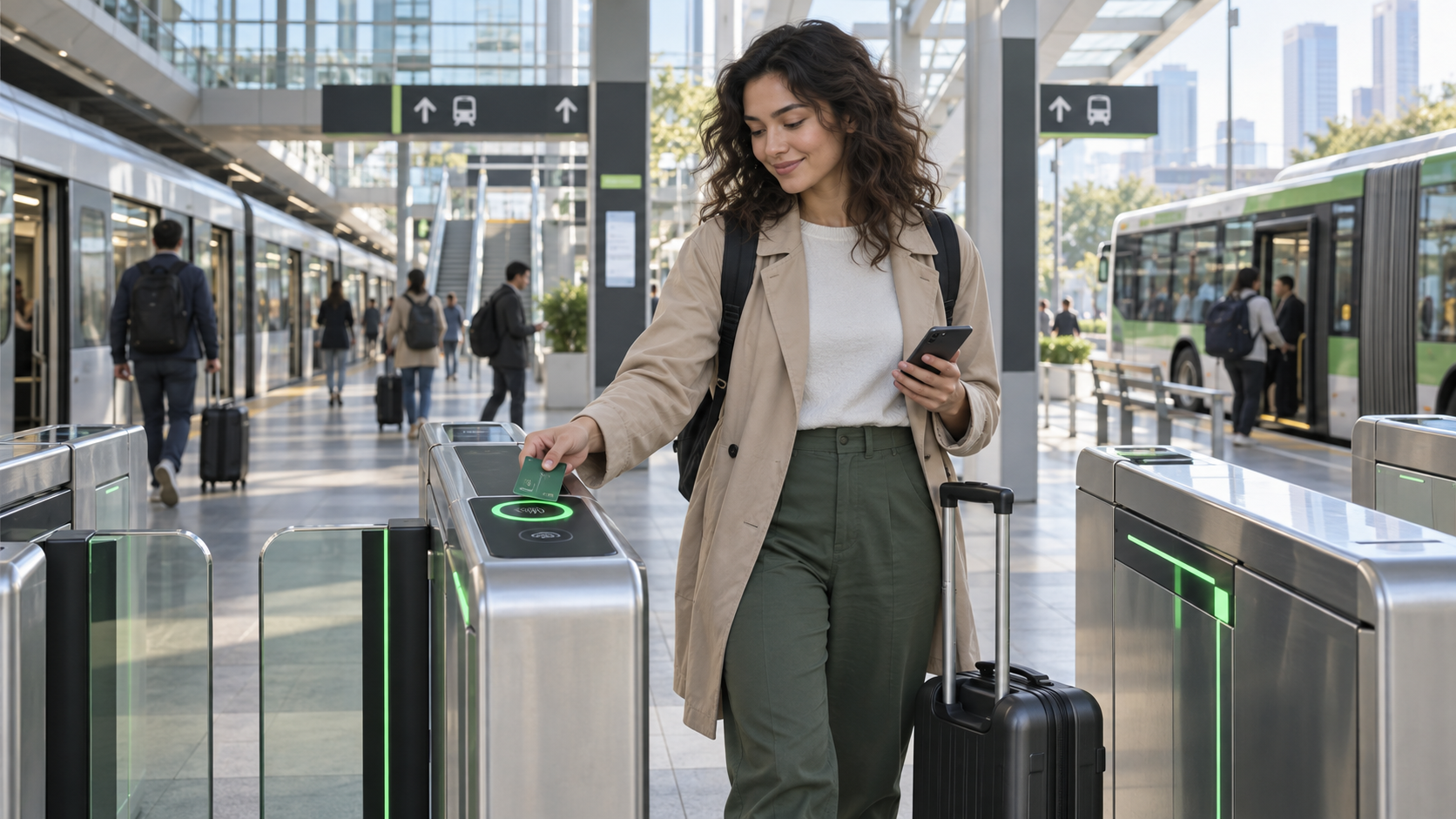
Quick answer: before using public transport abroad, check the official operator’s payment page for four things: whether foreign contactless cards are accepted, whether you must tap both in and out, whether one card can pay for more than one person, and whether a local transit card or pass is cheaper. Use the exact same physical card, phone or watch throughout each journey, keep a backup payment method, and confirm foreign-transaction fees with your bank.
Paying for a bus or metro in another country can look simple—tap a card and go—but small differences cause expensive mistakes. A city may accept bank cards only on some modes. A phone and the physical card stored in its wallet may count as two different payment methods. One network may require a tap only when boarding; another may charge a maximum fare if you forget to tap out. A foreign card can work perfectly yet create a bank fee.
This guide gives you a worldwide decision process rather than pretending every transport system works the same way. Fare rules change, so verify the current instructions on the official operator website before travel.
The four payment systems you will encounter
Most urban transit payments fall into one or more of these categories:
- Open-loop contactless: you tap a bank card or a card stored in a phone or watch.
- Local stored-value card: you buy a reusable transit smartcard, load money and tap it at readers.
- App or mobile ticket: you buy or activate a ticket in an official app, display a barcode or load a transit credential into a wallet.
- Paper ticket or cash: you buy from a machine, counter, shop or driver, then validate if required.
A city may use different systems on buses, suburban trains, ferries and airport services. Do not assume the payment method advertised for the metro covers every operator in the region. If you are still building the route, start with our step-by-step public transport trip guide, then check payment separately for each mode.
The five-minute payment check before you travel
Search the official transport authority or operator—not a reseller—for “fares,” “tickets,” “contactless” or “visitor travel.” Record:
- accepted card networks and whether cards issued abroad work;
- which modes and geographic areas accept the method;
- whether the system requires tap-on only or tap-on and tap-off;
- daily or weekly fare caps and how they are calculated;
- transfer discounts or time limits;
- children, student, senior and disability concessions;
- whether every traveler needs a separate card or device;
- cash acceptance and change policy;
- app account, phone-number or local-address requirements; and
- airport, premium or intercity services excluded from normal fares.
Take screenshots or save the official page offline. If a payment method fails at a gate, you need the backup instructions while standing in the station, not later at the hotel.
When to use a contactless bank card
Open-loop contactless is often the easiest option for a short visit. It avoids buying and refunding a local card, topping up a balance or navigating a ticket machine. Transport for New South Wales, for example, tells visitors they can use an accepted bank card or mobile device and receive the same adult fare and many of the same benefits as an Opal card. Auckland Transport also offers contactless adult fares and automatic daily capping.
Contactless is a good default when:
- the official operator confirms your card type and issuing country are accepted;
- you qualify for the standard adult fare;
- your bank does not add costly foreign or per-transaction fees;
- the contactless coverage includes every mode you plan to use; and
- you can dedicate one card or device to one traveler.
Acceptance is not universal. Transport for London says many cards issued outside the UK work, while warning that some foreign-issued cards may not and that issuers may charge overseas fees. Toronto’s TTC accepts certain international credit and debit products but distinguishes them from ordinary foreign debit cards. Check the network and your bank rather than relying only on the contactless symbol.
Use the same card or device every time
In account-based fare systems, a physical card and that same card inside a phone wallet usually have different device identifiers. The back office may therefore treat them as separate passengers. If you tap in with a phone and tap out with the physical card, the system may see two incomplete journeys and charge default or maximum fares.
Pick one payment token and keep using it:
- physical bank card;
- phone wallet;
- smartwatch wallet; or
- local transit card.
Transport for New South Wales explicitly instructs riders to use the same device or card to tap on and off. It also says to keep cards separated to prevent “card clash.” Fare caps and transfer benefits can depend on this consistency, so use the same method across the day or week when the local rules require it.
Know whether to tap out
There are three common patterns:
- Tap on and tap off: common for distance- or zone-based rail, metro and ferry fares.
- Tap on only: common on flat-fare buses and some trams.
- Show or validate a ticket: common in proof-of-payment systems without exit gates.
Follow the rule for the specific mode. In London, Oyster guidance tells passengers to touch in and out on the Tube and many rail services, but only touch in on buses and trams. In Sydney, most covered journeys require the same card or device at both ends. Missing a required tap can trigger a default, maximum or penalty fare even when you genuinely traveled.
Wait for the reader’s success signal—usually a green light, tone or gate opening. Do not wave a wallet containing several cards over the reader. Remove the intended card, or present only the unlocked device you chose.
Understand bank fees, pending charges and fare aggregation
A foreign contactless card can create three charges that look confusing:
- Transit fare: the final amount calculated by the operator.
- Preauthorisation or verification hold: a small temporary amount used to verify the card.
- Bank fee: a foreign-transaction, currency-conversion or debit-processing charge from your issuer.
Some networks combine a day’s journeys and charge once overnight. Auckland Transport says foreign cards may incur transaction fees and that daily travel is charged as one overnight payment, while a small preauthorisation may appear first. Transport for New South Wales similarly warns that overseas issuers may charge a foreign-transaction fee.
Ask your bank whether fees apply per transaction or per daily settlement. A card with no foreign-transaction fee may be ideal; a card that charges a fixed fee for every transit settlement can make a local prepaid card cheaper. Keep enough available credit for holds, especially when several travelers use separate cards.
When a local transit card is better
A local stored-value card can be the safer choice when foreign bank cards are not accepted, when concessions require it, or when contactless coverage is incomplete. It can also help travelers control spending without exposing a bank card at every gate.
Choose a local card when:
- you will stay long enough to justify the purchase or deposit;
- the card works across several local operators;
- you need a child, student, senior or accessibility fare;
- your bank charges foreign-use fees;
- your contactless card is incompatible; or
- the network requires stored value in areas where bank cards are not supported.
Check the card price, refundable deposit, minimum top-up, refund rules and accepted top-up payment methods. Japan illustrates why coverage matters: JR Central’s TOICA is reusable and interoperable with many transport IC cards, but its official guidance says it cannot be used to cross between certain separate IC-card areas. A familiar tap card may still have geographic limits.
Compare day passes with automatic fare capping
A day pass is bought in advance for unlimited eligible trips. Fare capping calculates pay-as-you-go journeys and stops charging after you reach a defined threshold. They can produce similar totals, but only if your travel, modes, zones and payment method qualify.
Before buying a pass, estimate your likely trips. Check whether:
- the cap includes airport or premium services;
- the “day” follows the calendar or a custom transit-day cutoff;
- weekly caps run on fixed weekdays or a rolling period;
- all trips must use the same card or device;
- family or group products exist; and
- transfer discounts already reduce the pay-as-you-go total.
London and Auckland both demonstrate automatic capping, but their rules, eligible products and operating days are different. Treat “fare cap” as a feature to investigate, not a portable rule.
Using official apps and mobile tickets
Apps can be useful where contactless is unavailable or where advance purchase unlocks a better product. They may hold QR tickets, sell timed passes, show balances or link a concession. Singapore’s SimplyGo, for example, supports several contactless bank-card and mobile-wallet options while also offering local cards and tourist products.
Before depending on an app, test:
- whether the app is available in your home app store;
- whether signup accepts your phone number and address;
- whether your bank passes verification;
- whether the ticket must be activated before boarding;
- whether screenshots are accepted;
- whether the ticket works offline; and
- what happens if your battery dies.
A phone may be both payment method and proof of entitlement. Keep it charged, enable the required near-field communication setting, and carry a backup that does not depend on the same device. On an accessible journey, incorporate ticket machines, gates and mobile-reader reach into the checks in our accessible public transport planning guide.
Cash and paper tickets are not obsolete—but do not assume they work
Cash remains important in some cities, especially on informal services, rural routes and buses without open-loop payment. Elsewhere, vehicles are cashless or require exact change. Ticket machines may accept cash while drivers do not.
If you plan to use cash:
- confirm it is accepted on the exact mode;
- carry small local denominations;
- check whether drivers give change;
- learn whether you must validate the ticket after purchase; and
- keep the ticket until you have left the paid area.
In proof-of-payment networks, buying a ticket may not be enough; it might need a timestamp or validation before boarding. Inspect the machine instructions and watch for validators near platforms or vehicle doors. If the process is unclear, ask official staff before entering.
Groups, children and concession fares
Do not pass one bank card back through a gate for several adults unless the official rules explicitly permit group payment. Many contactless systems bind one card or device to one traveler so they can reconstruct the journey and calculate the correct cap.
Children and concession holders often need a local card, registration or proof of eligibility. A foreign student or senior card may not qualify. Transport for New South Wales notes that some concession types cannot use ordinary contactless concessions, while London visitor guidance says travelers generally need separate payment media.
For families, compare individual contactless payment with visitor cards, family passes and child tickets. Do this before reaching the gate; staff may not be able to apply a concession retroactively.
What to do when a payment method fails
- Stop and read the reader or machine response.
- Do not repeatedly tap several cards from the same wallet.
- Try the same chosen card once more after removing it from the wallet.
- Ask official staff whether the card type or route is supported.
- Use your prepared backup: another bank card, local transit card, app ticket or cash.
- Save receipts and journey details if you need a fare adjustment.
If a bank card is declined, do not assume the account lacks money. Offline limits, fraud controls, issuer restrictions and unsupported card technology can all cause a failure. Contact the bank through its official channel if the transit operator confirms the card should work.
A reusable public transport payment checklist
- Official operator payment page saved offline
- Primary payment method tested and enabled
- Independent backup payment method
- Tap-in and tap-out rule understood for every mode
- One card or device assigned to each traveler
- Bank foreign-use fees checked
- Fare caps, transfers and exclusions understood
- Child or concession eligibility confirmed
- Phone charged and essential tickets available offline
- Small amount of local cash where useful
An AI public transportation planner can explain route options and transfers, but the official operator remains the source of truth for accepted payment methods, fares and inspection rules.
Frequently asked questions
Can I use my bank card for public transport abroad?
Often, but not everywhere. Confirm that the network accepts open-loop contactless, your card network and cards issued in your country. Also check foreign-transaction fees and keep a backup.
Can I tap in with my phone and tap out with the physical card?
Usually you should not. The phone and physical card may have different identifiers, causing two incomplete journeys or lost fare-cap benefits. Use exactly the same card or device throughout.
Can two people use the same contactless card?
Many systems require one card or device per traveler. Check the official local rule before traveling as a group.
Should I buy a local transit card?
It is often worthwhile when foreign contactless cards are unsupported, you need concessions, your bank charges fees, or the local card covers more modes and areas.
What happens if I forget to tap out?
On systems that require it, you may receive a default or maximum fare and lose transfer or capping benefits. Use the operator’s official journey-history or fare-adjustment process.
The practical takeaway
The easiest way to pay for public transport abroad is the method the official network supports across your entire trip—not necessarily the method that looks most familiar. Verify acceptance, use one card or device consistently, understand the tap rules, account for bank fees and carry a backup. Five minutes of payment research can prevent a missed vehicle, a penalty fare or a day spent fixing charges.
Official sources and further reading
- Transport for London: Visitor Oyster and pay-as-you-go guidance
- Transport for New South Wales: Best ways for visitors to pay
- Transport for New South Wales: Contactless payment rules
- Auckland Transport: Using contactless payments
- Singapore SimplyGo: Contactless bank-card guidance
- Toronto Transit Commission: Paying with debit or credit cards
- JR Central: TOICA coverage and use