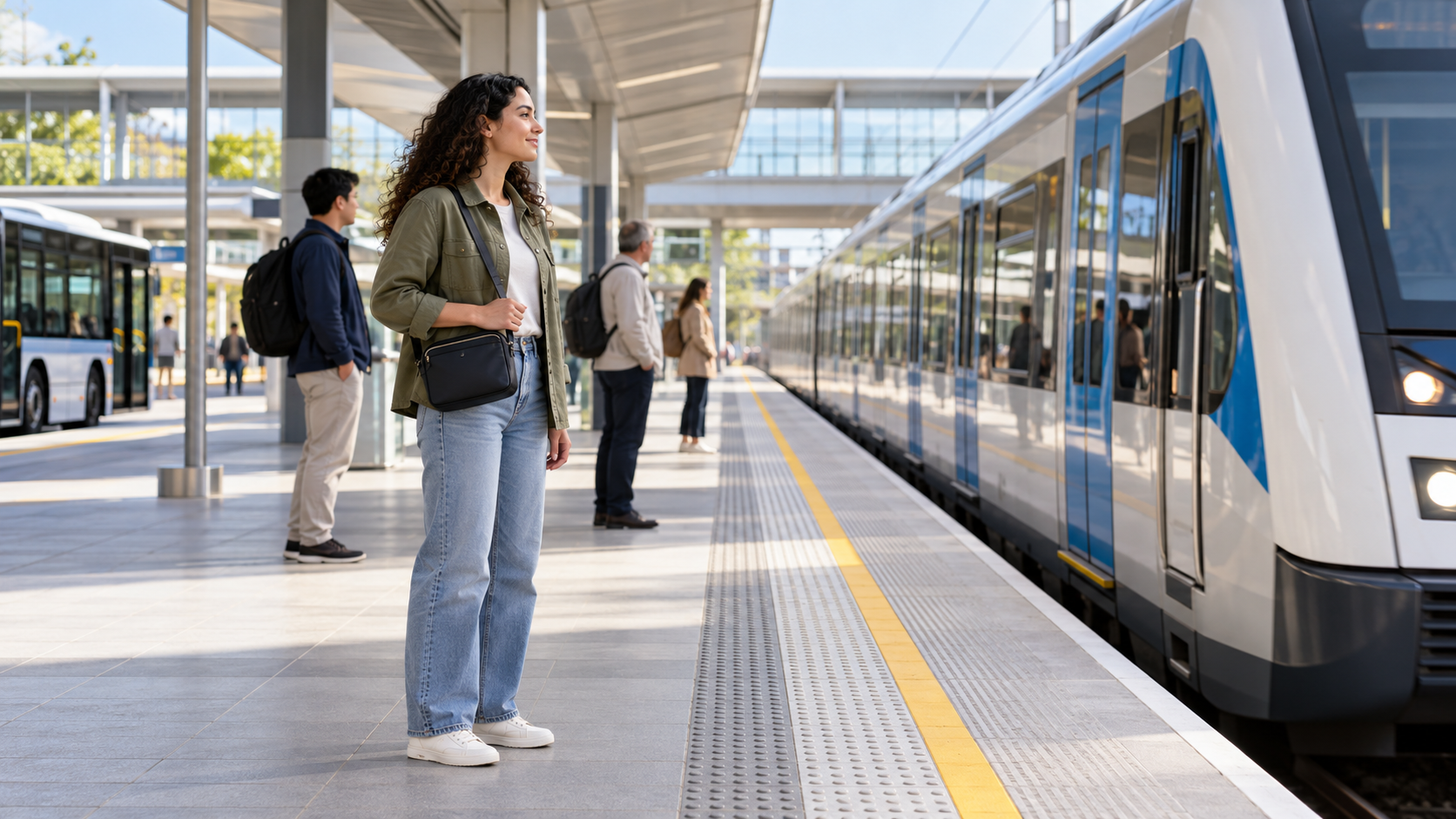
Quick answer: stay safer on public transport by planning the full route, checking live service information, waiting in the designated area, staying behind platform and curb markings, and boarding without rushing. Keep belongings closed and within reach, remain aware of announcements and your surroundings, identify staff and help points, and use the local emergency service for immediate danger.
Public transport carries millions of people safely every day. Good safety planning is not about expecting something bad to happen; it is about reducing preventable risks from falls, traffic, unfamiliar stations, crowded doors, lost belongings and unexpected disruptions. The exact rules and reporting channels vary worldwide, so use this guide as a framework and confirm local operator instructions.
1. Plan the whole route before leaving
A safer trip begins before the stop. Check the route, direction, transfer points, service alerts and final walk. Know when the next service runs so you do not need to sprint or wait much longer than expected.
Save these details offline:
- route numbers, line names and destination signs;
- the correct platform, stop or side of the street;
- transfer station and realistic walking time;
- the operator’s official help and reporting channels;
- the address and safest practical route from the final stop; and
- a backup if the service is cancelled or the station closes.
Pennsylvania’s transport guidance, LA Metro and Toronto Police all recommend planning before travel. Our public transport planning guide explains how to build the route leg by leg.
2. Choose a safe place to wait
Wait at the designated stop or platform where the driver can see you and where boarding is permitted. Stay in a well-lit, active area near other passengers, staff, help points or visible cameras when available. Avoid isolated shortcuts and unauthorized access routes.
At a roadside stop, stand back from the curb until the bus has stopped. At a station, remain behind the marked safety or tactile line. Do not sit on a platform edge, lean over it or enter the track area for any reason.
TransLink, British Transport Police and Maryland Transit Administration all tell riders to remain behind platform markings and keep off tracks. If something falls onto the track, notify staff or use a help point—never retrieve it yourself.
3. Do not run for a bus or train
A missed service is frustrating, but running on stairs, escalators or a crowded platform creates a more serious risk. Allow time to reach the correct boarding point. Once doors begin closing, wait for the next vehicle.
Maryland Transit Administration and Pennsylvania’s public transport guidance both advise riders not to run for a bus or train. Singapore’s Land Transport Authority makes the same point for escalators: use the handrail and do not rush to catch a service.
If you repeatedly face a connection that requires running, the itinerary does not contain enough transfer time. Use our connection-time checklist to choose a realistic buffer.
4. Board and exit deliberately
- Confirm the route and destination before approaching.
- Let passengers leave first.
- Watch the gap, step and floor height.
- Use handrails where provided.
- Move clear of the doorway after boarding.
- Wait for a complete stop before exiting.
- After leaving a bus, cross only where you can see traffic clearly.
Miami-Dade Transit advises riders to watch their step, hold handrails and avoid walking directly in front of a bus after exiting. Keep children close and secure wheeled items so they cannot roll toward a road, platform edge or door.
5. Stay stable while the vehicle is moving
Take a seat when one is available. If standing, hold a rail or strap before the vehicle moves and keep holding it through turns and braking. Do not stand in stairwells, lean against doors or move between areas when the vehicle is accelerating.
Keep aisles, doors and emergency equipment clear. Place bags where you can control them without creating a trip hazard. Singapore LTA’s bus-safety campaign emphasizes holding the handrail, not rushing and remaining seated when mobility needs make standing less safe.
If you use a wheelchair, mobility aid or stroller, follow the operator’s designated-space and restraint instructions. Our accessible journey planning checklist covers ramps, assistance, lifts and backup arrangements.
6. Keep belongings secure and visible
Close bag zips and keep valuables in an inside or secured pocket. Hold a bag on your lap, against your body or between your feet rather than leaving it on a seat or out of sight. At doors and in crowds, pay particular attention to phones, wallets and loose luggage.
British Transport Police advises passengers to keep possessions with them and valuables out of sight. RATP’s traveler guide similarly warns riders to protect belongings and take bags when leaving the train.
Pack only what you can manage while keeping one hand free where practical. For larger items, use our public transport with luggage guide.
7. Use phones and headphones without losing awareness
A phone is useful for live updates and emergencies, but it can also hide announcements, hazards and people moving around you. Stop walking before checking a complicated route. Lower headphone volume or remove an earpiece in stations, near roads and while boarding.
Transport for NSW advises riders not to be distracted by a phone. TransLink recommends looking up and around, especially in low-light conditions. Put the device away near vehicle doors when you do not need it, and avoid displaying personal information in public.
8. Handle unfamiliar systems calmly
Before entering, identify the line, direction and destination terminus. Follow official signs and announcements rather than following a crowd. If uncertain, ask staff a precise question such as, “Does this train stop at Central Station?”
Save place names in the local script when travelling in another language. The language-barrier transit guide explains how to prepare route names and ask for help without relying on a live connection.
If you board the wrong service, get off at the next safe, staffed or well-connected stop when practical and replan. Do not attempt to exit after doors begin closing.
9. Add safeguards after dark
Night travel can involve longer waits, reduced staffing and quieter final walks. Check the last complete connection, not only the last departure from the origin. Wait in a bright, active area and let a trusted person know the route and expected arrival when appropriate.
Queensland’s night-security guidance recommends planning in advance, waiting near other people and choosing a comfortable location near staff. TfL and Transport for NSW also emphasize planning and well-lit waiting areas. For a complete workflow, use our late-night public transport guide.
10. What to do if a person or situation feels unsafe
Trust the signal that something is wrong and create distance early. Move toward staff, the driver, a staffed area, help point or other passengers. Change carriage or exit at a safe staffed stop if that is the better option. Do not confront someone when doing so could escalate the risk.
If you experience or witness harassment, use the operator’s official reporting channel. Some networks provide discreet text or app reporting; others direct passengers to staff, transit police or emergency services. RATP, TTC and Transperth all publish network-specific ways to seek help.
For immediate danger or a medical emergency, use the local emergency number. Do not rely on a phone number from another country. Give the vehicle or route, direction, nearest stop, carriage if known and a concise description.
11. Know where help and emergency equipment are
As you enter a station or vehicle, notice staff positions, help points, emergency intercoms and exits. Read their instructions before an incident occurs. Emergency devices are for genuine safety situations; misuse can delay service or create additional danger.
In an emergency, remain calm, follow staff or operator announcements and do not self-evacuate onto tracks or into traffic unless instructed or immediate danger makes remaining impossible. Maryland Transit Administration advises riders to know emergency alarms and exits and follow operator, conductor or transit-police instructions.
12. Report unattended or suspicious items safely
Do not touch, open or move an unattended item. Create space and tell transit staff, the driver, security or the appropriate local authority. Provide the exact location and a simple description.
Singapore LTA, British Transport Police and RATP all direct passengers to report suspicious or unattended items. Avoid spreading unverified claims or images online while staff are assessing the situation.
13. Reassess safety during disruptions and bad weather
A disruption can create unexpected crowds, changed platforms, replacement buses and longer outdoor waits. Slow down, follow official directions and do not push toward a closing door. If the new route introduces an isolated walk, inaccessible transfer or unsafe weather exposure, compare waiting, rerouting and postponing.
Transport for NSW notes that wet weather can increase slips and falls and that severe conditions can disrupt services. Check official alerts and weather before leaving. Our public transport disruption guide provides a structured decision process.
14. Adjust the plan for children and other riders
Hold a young child’s hand near roads, gates and platforms. Agree on what to do if separated and keep the child’s essential contact information available in an age-appropriate form. Do not split the group to force entry through closing doors.
People with reduced mobility, sensory needs or invisible conditions may need more time or a seat. Give priority areas to those who need them and ask staff for help early. Families can use our guide to public transport with children for stroller, transfer and separation planning.
Public transport safety checklist
- Full route, direction and final walk checked
- Live alerts and weather reviewed
- Backup route and realistic transfer time prepared
- Official help and reporting channels saved
- Phone charged and essential information available offline
- Well-lit designated waiting area identified
- Bag closed and valuables secured
- Platform lines, traffic and door areas respected
- Help points and exits noticed
- Trusted contact informed when appropriate
Frequently asked questions
Where is the safest place to sit on public transport?
There is no universal seat. Choose a place where you feel comfortable, can hold on safely and can reach staff or help if needed. At night, some operators recommend sitting near the driver or in an occupied carriage.
What should I do if someone is making me feel unsafe?
Create distance, move toward staff or other passengers, change carriage or exit at a safe staffed stop when appropriate, and use the operator’s reporting channel. Call the local emergency service for immediate danger.
What if I drop something onto train tracks?
Do not enter the track area. Tell station staff or use a help point so trained personnel can handle it safely.
Is it safe to use my phone on public transport?
Use it when needed, but stop walking for complex tasks, stay aware of doors and surroundings, and put it away when it is not necessary—especially in crowded areas.
How can I make a late-night trip safer?
Check the last complete connection, minimize waiting, use well-lit active areas, plan the final walk, keep the phone charged and share the route with a trusted person when appropriate.
The practical takeaway
Most public transport safety comes from ordinary, repeatable habits: plan ahead, allow time, wait in the right place, board without rushing, hold on, keep belongings secure and know how to reach help. Stay alert without becoming fearful, and let current operator guidance and local authorities lead during an incident.
Official sources and further reading
- Transport for NSW: safety and security
- TransLink Vancouver: safety and security
- Maryland Transit Administration: ride safely
- Miami-Dade Transit: passenger safety
- PennDOT: public transport safety and etiquette
- Toronto Police Service: transit safety
- British Transport Police: travel safely by rail
- Transport for London: staying safe while travelling
- Singapore LTA: staying safe on public transport
- Singapore LTA: public transport security
- Queensland Government: public transport safety at night
- Transperth: safety and security
- Toronto Transit Commission: safety and security
- RATP Paris: safety and travel support
- LA Metro: rider safety guide