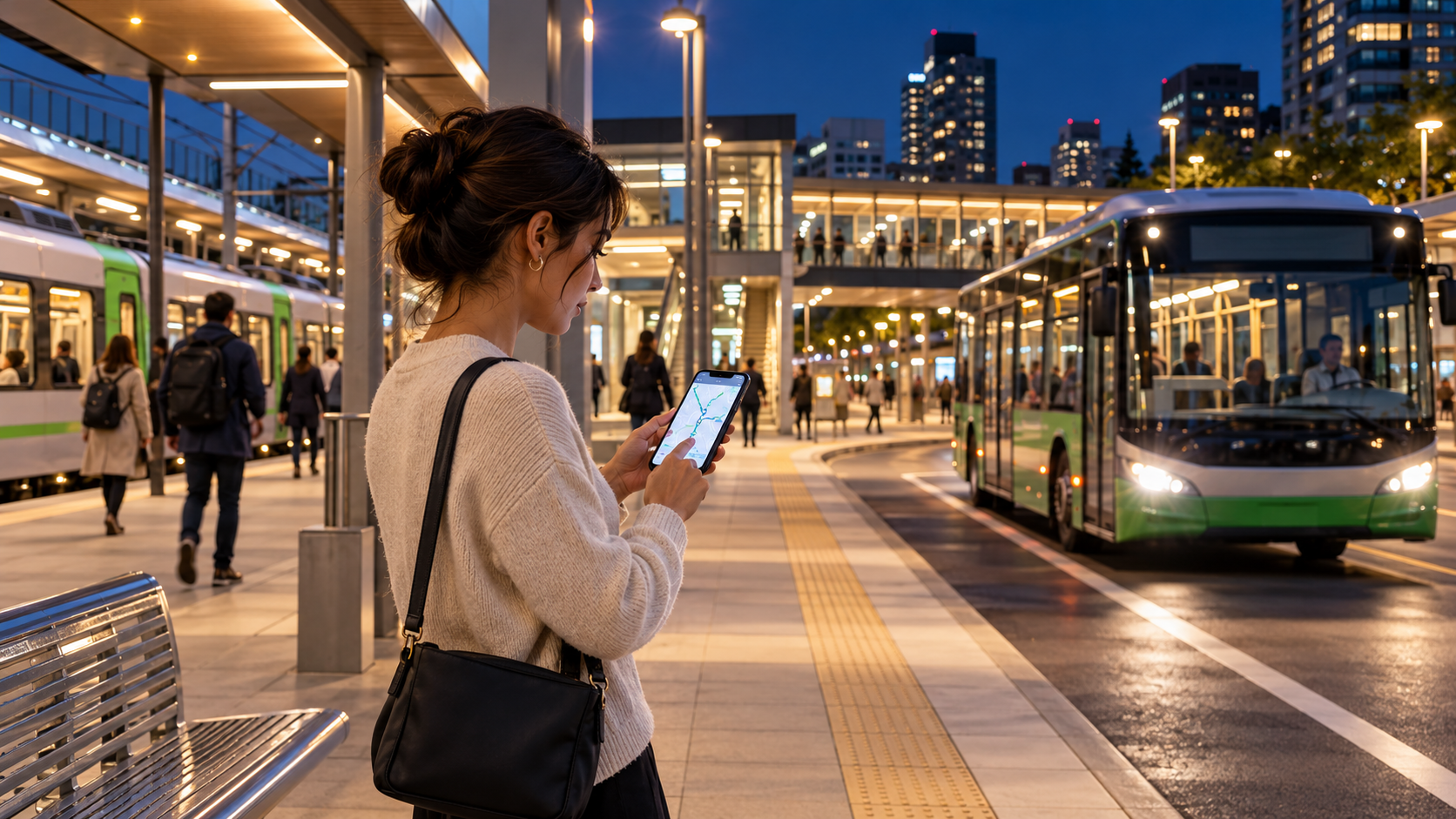
Quick answer: plan a late-night public transport trip by checking the entire journey for the exact date and departure time—not just the first vehicle. Confirm the last usable connection, night-only route numbers, stop locations, fare rules, service alerts and the walk from your final stop. Add a buffer, keep your phone charged, wait in a well-lit active area and decide in advance when you will switch to a safe backup.
Late-night transit is not simply daytime service with fewer passengers. Lines may stop early, run local instead of express, use replacement buses, serve different platforms or operate only on certain nights. A journey planner may show a route that works only if every connection is made exactly on time.
This guide applies worldwide. Night networks differ sharply by city and day, so verify every detail with the current official operator timetable and alert page.
1. Define the exact night you are traveling
Start with the calendar date, the time you expect to leave and the time after midnight when you might still be traveling. “Friday night” can mean early Friday morning to one person and the hours after Friday evening to another. Timetables may group post-midnight trips with the previous service day.
Enter the full date and time in the official journey planner. Check for:
- weekday, weekend and public-holiday differences;
- special-event extensions or closures;
- seasonal timetables;
- engineering work that begins late in the evening; and
- early-morning trips displayed as times after 24:00 in a timetable.
Do not reuse a route from another night without checking. Zurich’s ZVV night network, Oslo’s Ruter night buses and Brisbane’s Nightlink services, for example, publish specific operating nights and hours. They illustrate why “there is a night bus” is incomplete information.
2. Find the last complete journey, not the last first leg
The last train from your origin is useful only if the onward connection still operates when you arrive. Build the trip backward from the destination:
- find the final service that reaches your destination area;
- identify its departure stop and time;
- work backward through every connection;
- add walking and platform-change time; and
- choose an earlier first leg if the connection is tight.
A connection that allows two minutes on paper may be unusable across a large station at night, especially if entrances, lifts or passageways are closed. Our guide to choosing enough time between train connections explains how to build a realistic buffer.
3. Check whether a separate night network takes over
Some cities replace daytime rail with dedicated night buses, while others keep selected trains running or operate weekend-only night routes. The night network may use:
- route numbers prefixed or suffixed with “N”;
- different central departure hubs;
- stops on main roads near, but not at, railway stations;
- different frequencies and stopping patterns; or
- special rules for boarding or requesting a stop.
Transport for NSW says NightRide buses replace most Sydney train services during part of the overnight period and may stop at stations or on nearby main roads. RATP explains that Paris’s Noctilien bus network takes over during hours when most metro service is unavailable. In both cases, the correct night stop can differ from the daytime platform you know.
Save the night map and stop location. If the network diagram is unfamiliar, use our guide to reading lines, directions and transfer symbols.
4. Treat frequency as part of the route
A route that runs every hour is not equivalent to one that runs every ten minutes, even if the map looks identical. A missed connection can turn a short journey into a long wait.
Record the scheduled departure you intend to use and the next one. Check whether the published time is a fixed timetable or a real-time estimate. For frequent services, look for the expected interval; for infrequent services, use the exact departure.
The MTA’s late-night map notes that not every daytime line runs overnight and that most services operate locally. This changes both frequency and journey time. Never calculate the night trip from a daytime express schedule.
For help interpreting the display, see scheduled versus real-time transit arrivals.
5. Check alerts twice
Overnight hours are commonly used for maintenance because passenger demand is lower. Check official alerts when planning and again before leaving. Look for:
- partial closures and suspended sections;
- platform or stop changes;
- replacement buses;
- trains running local instead of express;
- lift or escalator outages;
- temporary entrance closures; and
- event crowd controls.
A saved screenshot cannot show a new disruption. Keep the official alert page available, and know how to identify the affected route and direction.
6. Inspect the final stop and last-mile walk
The fastest stop in daylight may not be the best one after dark. Compare the final walking route for lighting, open entrances, road crossings, gradients and active surroundings. Verify that gates or station exits remain open for your arrival.
If you are unfamiliar with the area, save the walking route offline and note a clear landmark. Avoid discovering at 1 a.m. that the planned exit is locked or the bus stops on the opposite side of a divided road.
Transport for NSW advises night travelers to consider where they may be vulnerable, wait in well-lit places, keep a charged phone accessible and share their route and expected arrival. Adapt those principles to local conditions and your own needs.
7. Confirm payment and ticket validity
Night services may use the normal fare, a separate fare or a different validation process. Check whether your ticket remains valid across midnight and whether transfers expire after a set time.
Prepare payment before reaching the stop. Ticket offices and retailers may be closed, machines may accept limited payment methods and a contactless card may need enough available balance. If a night bus is operated by a different company, confirm that the same pass or card is accepted.
Do not rely on a driver to sell the exact ticket you need unless the official operator says onboard purchase is available. Save the ticket offline if it lives in an app.
8. Set a personal departure deadline
Choose a time when you will stop waiting for “one more” delayed service and move to the backup. The deadline should protect the last reliable connection, not the last theoretical departure.
For an event, restaurant or work shift, estimate the time needed to leave the building, collect belongings, reach the stop and find the correct platform. Add extra time for crowds. Set an alarm before the deadline rather than depending on memory.
If the first leg is delayed enough to threaten the final connection, replan immediately. Our public transport disruption playbook provides a structured wait-versus-reroute decision.
9. Build a realistic backup before you need it
A backup is not simply “take a taxi.” It should be specific and available in the place and time you will need it. Options might include:
- an earlier night route;
- a parallel bus or rail line;
- a staffed interchange where several services meet;
- a licensed taxi rank or booked private-hire service;
- a safe pickup point for someone you know; or
- remaining at a staffed, open location until morning service.
Confirm the backup’s price range, payment method, pickup point and operating hours. Do not assume a ride-hailing vehicle will be immediately available after a large event.
10. Choose the waiting environment
Wait in a well-lit area with clear sightlines and, when possible, near staff, other passengers, help points or CCTV coverage. Stay behind platform safety markings and remain aware of approaching vehicles.
Budapest’s BKK advises night riders to sit close to the driver on a bus or use the first tram car, and to seek help from drivers or security staff if they feel in danger. Local advice varies, but the broader principle is useful: identify where official help is available before boarding.
Keep personal items secure and avoid displaying valuables unnecessarily. Stay alert to announcements and vehicle destinations without becoming absorbed in your phone.
11. Share the useful parts of the plan
If appropriate, tell a trusted person your intended route, departure time and expected arrival. Share a live location only with someone you trust and only if it helps. Agree on what they should do if you do not check in.
Keep your phone charged, but do not let constant navigation drain the battery. Save screenshots, lower brightness and close unnecessary apps. Carry a power bank where permitted.
12. Plan for language and accessibility at night
Staffing, lifts and assistance can differ at night. If you need step-free access or boarding assistance, confirm that it is available for the exact late service. A replacement bus may not reproduce the accessibility of the rail service it replaces.
For an unfamiliar language, save route names, stop codes and your destination in the local script. Our guide to using public transport without speaking the local language explains offline translation and precise help requests.
For mobility, sensory or cognitive access needs, use the accessible public transport planning checklist and verify late-night staffing directly with the operator.
What to do if you miss the last service
- Move to a safe, well-lit and preferably staffed location.
- Confirm that the service is truly finished and has not moved to another stop.
- Check the official night network and alert page.
- Use the backup you planned, verifying the provider and pickup point.
- Tell a trusted person that the plan changed.
- If you feel threatened or face an emergency, use official help points or the local emergency service.
Do not enter closed platforms, walk along tracks, cross restricted areas or accept an unverified ride. British Transport Police advises night rail passengers to speak to police or rail staff when they need help; use the equivalent official channel where you are traveling.
A practical late-night transit checklist
- Exact date and post-midnight service day confirmed
- Last complete journey checked backward from destination
- Night-only route and stop location saved
- Frequency and next departure recorded
- Official alerts checked twice
- Final walk and station exit reviewed
- Fare and ticket validity confirmed
- Personal departure deadline set
- Specific backup route or pickup prepared
- Charged phone and offline information ready
- Trusted contact informed when appropriate
Frequently asked questions
How do I find the last train or bus?
Use the official operator’s journey planner for the exact date and time, then verify the timetable and alerts. Check that every onward connection still operates.
Does an after-midnight trip count as the next day?
Sometimes. Journey planners and timetables handle service days differently. Enter the precise date and time and read any timetable note about after-midnight services.
Why does the night map differ from the daytime map?
Some lines stop, run locally, change frequency or are replaced by buses overnight. Always use the official night map and live alert information.
Should I take the last possible connection?
Avoid a fragile last connection when an earlier option is practical. Build a buffer for walking, platform changes, reduced frequency and minor delays.
What should I do if I feel unsafe while waiting?
Move toward a well-lit active area, staff, a help point or other official assistance. Contact a trusted person, and use the local emergency service if there is immediate danger.
The practical takeaway
A dependable late-night trip is built around the last complete connection, not the first departure. Check the exact night, identify the separate night network, inspect the final walk, set a deadline and prepare a specific backup. Live service information and personal judgment should always override an old screenshot or ideal timetable.
Official sources and further reading
- Transport for London: safer travel at night
- Transport for NSW: late-night services
- Transport for NSW: safety and security guidance
- RATP: nightly public transport service
- Translink Queensland: late-night services
- ZVV: nighttime network
- Ruter: night buses in Oslo and Akershus
- MTA: late-night subway service map
- BKK Budapest: night transport
- British Transport Police: travel safely by rail