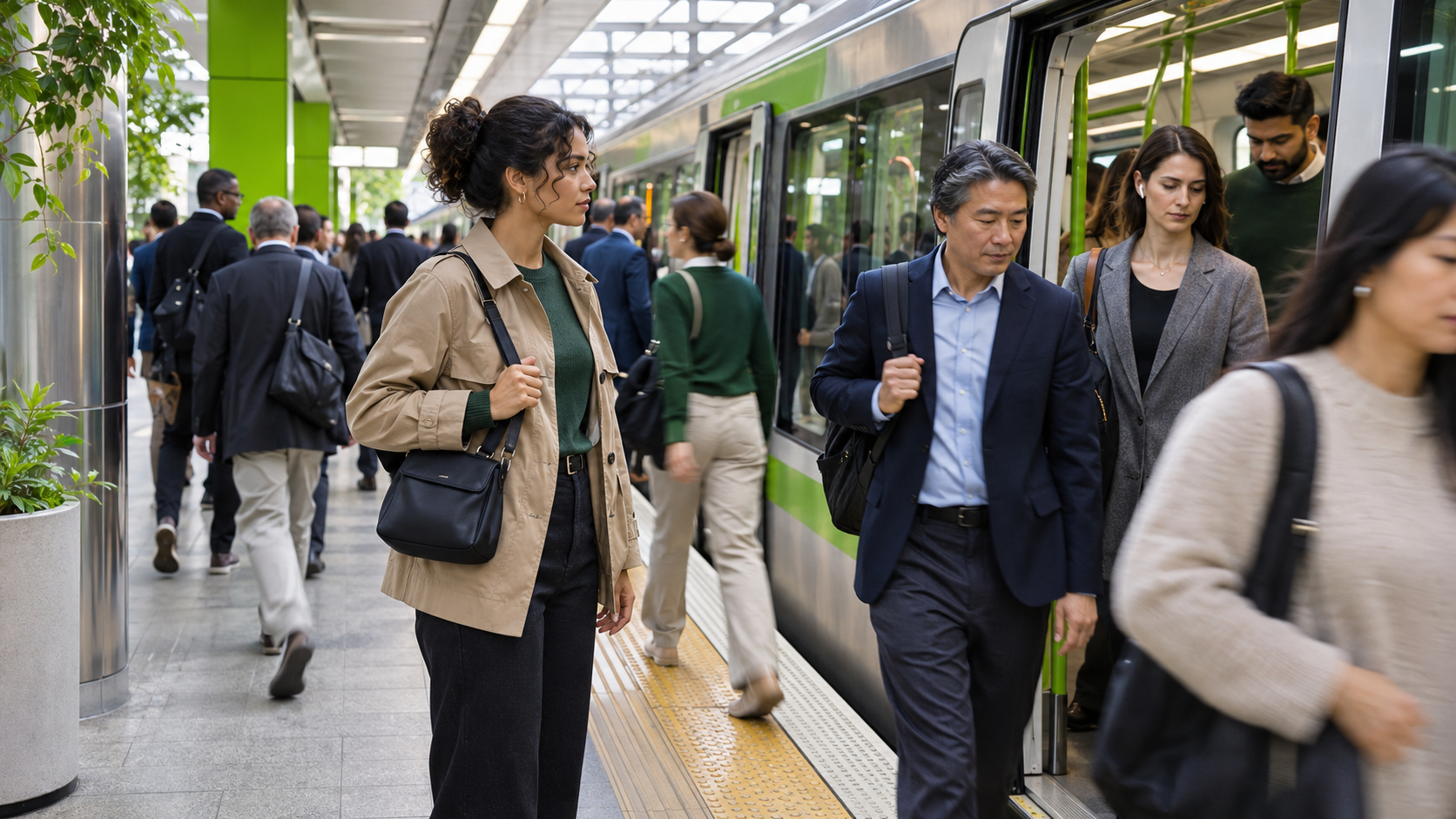
Quick answer: to use public transport during rush hour, check the operator's current peak period, compare nearby departure times and routes, arrive with your fare ready, leave extra time, and wait to the side while passengers exit. Move away from doors after boarding, keep bags compact, hold a handrail, and let a dangerously crowded vehicle leave rather than forcing your way aboard.
Rush hour is manageable when you plan for capacity as well as travel time. The fastest route on a quiet afternoon may not be the most reliable at 8 a.m. A route with slightly more walking, a larger interchange or more frequent vehicles can produce a calmer and more dependable trip.
What is rush hour on public transport?
Rush hour, peak hour or the peak period is the part of the day when demand is concentrated, usually around work and school start and finish times. It is not necessarily one hour. It can span several hours, differ by direction and vary between buses, rail, ferries and individual stations.
Local definitions illustrate the variation. Singapore's Land Transport Authority describes rail peak frequencies around 7–9 a.m. Transport for NSW uses defined morning and afternoon peak windows for Opal fares from Monday to Thursday, while Transport for London publishes quieter periods that differ between rail and bus. Events, school calendars, weather, remote-work patterns and service disruptions can create a local peak outside the published window.
1. Find the real peak for your route
Do not rely only on a city's generic “rush hour.” Check the particular station, stop and direction. A train toward a business district may be busiest in the morning while the opposite direction has room. A bus feeding a station may peak earlier than the train it connects to.
Use the official journey planner or app to compare departures across at least an hour. Look for crowding indicators, predicted capacity, service frequency and disruption alerts. Transport for NSW's trip-planning tools can show service capacity and real-time changes. TfL lets riders inspect when individual stations and stops are busiest.
Save the complete itinerary, not only the first departure. Our step-by-step public transport planning guide explains how to verify every leg, direction and stop.
2. Shift your trip if a small change is possible
A modest change can matter more than choosing a different carriage. TfL reports that moving a weekday morning journey by 30 minutes can produce a noticeably quieter trip on its network. Singapore uses off-peak fare incentives and Travel Smart Journeys to spread morning demand. Dubai's RTA advises planning Metro journeys in off-peak hours to avoid congestion.
Compare three options:
- leave 15–30 minutes earlier;
- leave after the sharpest part of the peak; or
- change the work, appointment or check-in time when flexibility exists.
Check the fare impact before deciding. Some systems price peak and off-peak journeys differently, and the time used for pricing may be the first tap rather than the scheduled departure. Transport for NSW, for example, calculates the applicable fare period from tap-on time.
3. Choose for reliability, not just the shortest estimate
During the peak, compare routes using four measures:
- frequency: how soon the next vehicle comes if one is full;
- capacity: whether the mode and boarding point can absorb demand;
- transfer risk: how much delay the connection can tolerate; and
- walking environment: whether the alternative requires unsafe or inaccessible walking.
A direct bus in mixed traffic may be less predictable than a frequent train plus a short walk. A route boarding near the beginning of a line may be easier than joining at its busiest station. Singapore's LTA suggests alternative services and notes that first and last train cars may be less crowded on some journeys, but this is a local tactic rather than a universal rule.
For a route involving changes, read how public transport transfers work and protect enough time for crowded platforms and slower passenger flow.
4. Add a rush-hour time buffer
Extra vehicles often run at peak times, but that does not guarantee a faster door-to-door trip. Build in time for:
- queues at ticket machines, gates, lifts and escalators;
- one full vehicle passing without you;
- slower movement through corridors and transfers;
- traffic delays for buses and street-running trams;
- platform changes or short service gaps; and
- walking from a different entrance or stop.
TransLink in Metro Vancouver recommends extra time for rush-hour journeys. Transport for NSW tells rail passengers to plan ahead and avoid rushing on platforms, stairs and escalators. For a time-critical railway departure, use our guide to how early to arrive at a train station.
5. Prepare before reaching the gate or vehicle
Reduce decisions at the busiest point of the trip:
- load or activate the correct ticket before entering the queue;
- take the payment card or device out before the reader;
- confirm the line, destination and platform;
- close bags and secure loose belongings;
- remove a backpack if local guidance or crowding makes that appropriate; and
- keep headphones quiet enough to hear announcements.
Singapore's LTA advises taking out the intended card or device before reaching the fare gate and using the same one to tap in and out. This also prevents accidental card clashes. If the payment system is unfamiliar, see how to pay for public transport abroad.
6. Position yourself safely on the platform or at the stop
Stand behind the marked safety line and leave a clear path along the platform. Do not cluster at stairs, lifts or the first visible door if other boarding areas are available. Follow staff, markings and platform-screen-door indicators rather than predicting where an unmarked train will stop.
At a bus stop, wait where the driver can see you without stepping into the road. Keep the footpath accessible. If a queue exists, join it and follow local boarding rules. Do not run beside a moving bus or train; LA Metro tells riders to wait for a complete stop, while Metrolinx ambassadors discourage running at closed train doors because it can cause falls and delays.
7. Let passengers exit before you board
Stand to the side of the doorway, leaving the center clear. Wait until people have finished alighting, then board in an orderly flow. Chicago's CTA, LA Metro and Transport for NSW all explicitly direct riders to allow passengers off first.
Do not hold doors, push or wedge an object into the closing path. If the doors begin closing, wait for the next vehicle. Frequent peak service often makes that safer than creating a delay that affects everyone behind.
Give priority to riders who need additional boarding time or designated space, including wheelchair users. LA Metro instructs riders to let passengers with disabilities board or exit first. Follow the operator's staff directions because equipment and procedures differ.
8. Move inside and keep circulation clear
Once aboard, move away from the doorway unless you are exiting at the next stop and space permits. Use the aisle and interior standing areas so others can board. Keep these areas clear:
- doors and emergency equipment;
- aisles and stairs;
- wheelchair and mobility-device spaces;
- priority seats; and
- the driver's or operator's working area.
CTA rules prohibit belongings that block passenger movement or access to priority seating. LA Metro similarly tells riders to keep luggage away from doors, aisles and disability seating. When standing, distribute your weight, keep one hand available and hold a pole, strap or rail before the vehicle moves.
9. Manage bags, phones and valuables
Keep a backpack in front, low by your legs or in the position the operator recommends. Do not place it on a seat when others are standing. Secure zippers and keep your phone where it cannot be easily knocked away or taken.
Crowding can reduce awareness. WMATA advises staying alert, avoiding rail-car doors where jostling is more likely and watching for distraction tactics used by pickpockets. Keep one ear free for announcements and look up from the screen regularly. Our guide to staying safe on public transport covers practical personal-security decisions without creating unnecessary fear.
10. Know when not to board
Let the vehicle go if boarding would require pushing, leave you in a closing doorway, separate you from a child or companion, or prevent safe control of a mobility aid or luggage. Check the next departure before changing routes. A short wait may be better than a long detour.
On less frequent services, move to a different boarding position only when the platform permits safe movement. Never step into restricted areas or cross tracks. If repeated vehicles pass full, ask staff about an alternative line, temporary queue or nearby stop.
Rush hour with accessibility needs
Check the whole journey, not only whether the vehicle is accessible. Peak crowding can lengthen lift queues, station movement and boarding assistance. Verify:
- lift and escalator status;
- step-free entrances and interchange paths;
- whether assistance must be booked;
- where to wait for staff or a boarding ramp;
- space and priority policies for mobility devices; and
- a quieter departure when flexibility is available.
Do not assume crowding removes accessibility rights or priority spaces. Ask staff for support and allow extra time. Use our accessible public transport journey checklist to verify each link in the route.
Traveling with children, groups or luggage
Hold a child's hand near roads, platforms and doors, and decide where to regroup if separated. Board only when the whole group can do so safely. For detailed planning, see how to use public transport with children.
Large groups may need to split across vehicles. Transport for NSW warns that regular buses can reach capacity during peak periods and that a group may not be able to board one service. Assign a leader to each smaller group, share the destination and agree on a meeting point before entering the station.
With luggage, avoid peak travel where possible. Keep bags manageable in one trip and never block aisles or accessible spaces. Our public transport luggage guide explains sizing, storage and transfer choices.
Recheck live information during the trip
Peak service changes quickly. Check the official source before departure and again before a transfer. Distinguish a scheduled time from a vehicle prediction: a timetable entry does not prove the service is currently moving or has space.
If a gap appears, later vehicles and platforms may become unusually crowded. Consider an official alternative, wait in a safe area and protect the final connection. Our explanation of scheduled versus real-time arrivals helps interpret changing predictions.
Rush hour during disruption or a major event
A closure, severe weather or stadium crowd can create demand far beyond a normal weekday peak. Follow temporary signs and staff instructions, because normal entrances, platforms and stopping patterns may change. Do not assume an unofficial shortcut is safe or that every planned transfer will be recognized by the fare system.
Decide whether to wait, reroute, walk part of the journey or delay departure based on reliable information. Use our step-by-step disruption plan before abandoning a valid route or buying another ticket.
Rush-hour public transport checklist
- Local peak time and direction checked
- Nearby departure times compared
- Frequent backup route saved
- Fare loaded and payment method ready
- Extra time allowed for queues and one full vehicle
- Live status checked before departure
- Platform edge, stairs and doorways kept clear
- Passengers allowed to exit first
- Bag compact and valuables secured
- Handhold used when standing
- Accessible path and assistance verified
- Final connection protected
Frequently asked questions
What time is public transport rush hour?
It varies by city, service, day and direction. Many weekday peaks surround work and school times, but use the operator's current crowding, timetable and fare information for your exact route.
Is public transport more expensive during rush hour?
Sometimes. Some networks apply peak fares or off-peak discounts, while others charge the same fare all day. Check which event—such as tap-in time—determines the price.
Should I wait for the next train or bus if one is full?
Yes when boarding would be unsafe. Check the next departure and alternatives, stay behind platform markings, and ask staff if several vehicles pass at capacity.
Where should I stand on a crowded train?
Move into available interior space, keep doors and aisles clear, and hold a rail or strap. Follow vehicle markings and keep priority areas available to riders who need them.
How much extra time should I allow in rush hour?
Allow for queues, slower station movement, traffic and at least one missed vehicle when the trip is important. The right buffer depends on frequency and the cost of missing the final connection.
The practical takeaway
A good rush-hour trip begins before the platform. Identify the real peak for your route, shift the time when possible, choose a frequent and resilient itinerary, and arrive ready to pay. At the vehicle, stay behind safety markings, let people exit, move inside and keep doors and accessible spaces clear. If conditions become unsafe, let the vehicle go and use the backup you planned.
Official sources and further reading
- Transport for London: quieter times to travel
- Singapore Land Transport Authority: plan your journey
- Singapore Land Transport Authority: rail network frequency
- Transport for NSW: peak and off-peak fares
- Transport for NSW: metro and train safety
- TransLink Metro Vancouver: rider information
- Dubai RTA: Metro service guidance
- Chicago Transit Authority: riding the train
- Los Angeles Metro: rider guide
- WMATA: bus and rail safety
- Metrolinx: safe rush-hour platform movement