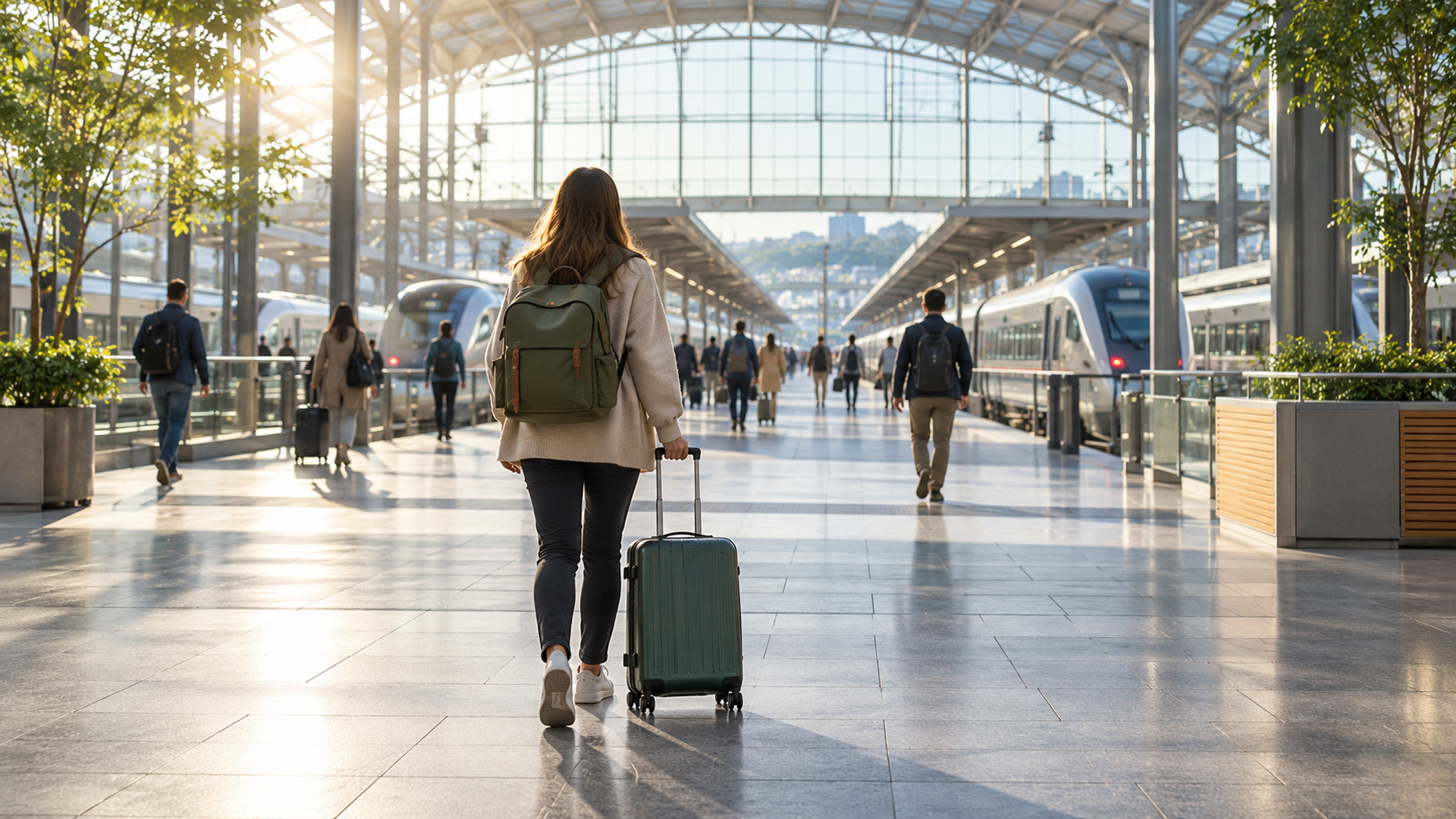
Quick answer: for a familiar local or domestic train with a ticket ready and no special procedures, arriving 15–30 minutes before departure is often a practical buffer. Allow 30–60 minutes for a large or unfamiliar station, ticket collection, checked baggage, children, a bicycle or boarding assistance. International trains with security or border controls may require 60–90 minutes or more. Your ticket and the operator’s current instructions always take priority.
The departure time is when the train is scheduled to leave—not necessarily the last moment you may step aboard. Gates, ticket checks, baggage acceptance or platform access can close earlier. The right question is therefore not only “how early should I arrive?” but “what must I complete before boarding, and when does each step close?”
There is no universal train-station arrival time
Rail systems handle boarding differently. A commuter train may use open platforms and contactless gates. A reserved intercity train may check tickets before platform access. An international service may add luggage screening, passport control and a firm check-in deadline. Some smaller stops are unstaffed and open only shortly before the train.
Official guidance illustrates the range. Amtrak generally recommends arriving 30 minutes before departure and earlier when a traveler needs baggage, ticketing or assistance. NSW TrainLink asks passengers without checked luggage to arrive at least 15 minutes early, while checked-luggage acceptance closes 30 minutes before departure. Eurostar recommends about 20 minutes on many continental European routes, but its London routes can require much longer because checks happen before boarding.
A practical starting point by train type
| Journey | Planning starting point | Add more time when |
|---|---|---|
| Familiar metro, suburban or commuter train | 10–15 minutes | You must buy or validate a ticket, change platforms or use an unfamiliar entrance |
| Domestic regional or intercity train | 20–30 minutes | The station is large, the seat is reserved, gates are used or the service is infrequent |
| Train with checked baggage or ticket collection | 45–60 minutes | The operator publishes an earlier baggage deadline or queues are likely |
| International train without pre-departure border controls | 30–45 minutes | You must navigate a major terminal, scan documents or make a cross-station transfer |
| International train with security or border controls | 60–90 minutes or the ticketed time | Peak travel, new entry systems, group travel or additional document checks apply |
These are planning ranges, not guarantees. A published check-in, gate-closing or baggage deadline overrides the table. For the full route to the station, use our step-by-step public transport trip-planning guide.
1. Read the ticket and operator instructions first
Check the booking email, mobile ticket and operator’s journey page close to travel. Look for separate times for:
- recommended station arrival;
- ticket collection or activation;
- baggage acceptance;
- assistance meeting point;
- security, passport or boarding control;
- gate or platform closure; and
- scheduled train departure.
Do not confuse a recommendation with a hard cutoff. Eurostar tells passengers to arrive at the time shown on the ticket and warns against arriving just before ticket checks close. Renfe says access control can close two minutes before departure and recommends extra time at large stations and those with luggage scanners. Trenitalia states that access to certain national trains is permitted until one minute before the departure shown on the ticket. Those final minutes are cutoffs, not sensible arrival targets.
2. Calculate time to the platform, not the station door
“Arriving at the station” should mean being inside with enough time to reach the correct boarding position. Add time for the walk from a car park, bus stop or street entrance, then for lifts, ticket gates, concourses and platform changes.
A large terminal can contain commuter, regional, high-speed and international areas under one name. Platforms may be announced late, and two similarly named stations can be several streets—or an entire city—apart. Confirm the exact station name and entrance before leaving. Our guide to reading transit maps, directions and termini can help you distinguish branches and destinations.
If you have never used the station, inspect its official map and accessibility information. Save the train number, destination, coach and seat offline. A train number is often more reliable than searching only for the final city when several services depart close together.
3. Have the ticket ready before you enter
A short arrival buffer works only when the ticket is usable. Before travel:
- download the ticket rather than relying on a live email connection;
- raise screen brightness and keep the barcode unobstructed;
- carry the payment card, railcard, discount proof or ID linked to the fare;
- check whether a paper ticket must be collected or validated; and
- confirm whether several tickets must be inserted or scanned together.
JR Central explains that passengers using the Shinkansen may need to insert the relevant tickets at the Shinkansen gate and keep them for onboard checks and exit. VIA Rail requires travelers to have a scannable ticket and valid identification available. If payment or ticket formats are unfamiliar, read how to pay for public transport abroad.
4. Add time for luggage and special items
Carrying a suitcase onboard is different from checking it with staff. A checked-baggage service has a deadline because bags must be accepted and loaded before departure. VIA Rail recommends arriving 30 minutes early in ordinary circumstances, but at least one hour early when a passenger needs to obtain a ticket or check baggage. NSW TrainLink says checked-luggage passengers should arrive more than 30 minutes early because check-in closes 30 minutes before departure.
Even without checked baggage, add time for lifts, narrow gates and locating the correct coach. Confirm size, weight and reservation rules before leaving home. For practical packing and movement advice, see how to travel on public transport with luggage.
Bicycles, pets and oversized equipment can have their own boarding location or reservation. Check the exact train, not only the railway’s general policy. SAYR’s guides cover taking a bicycle on public transport and traveling with pets on public transport.
5. Treat international rail as its own process
Crossing a border by train does not always resemble airport check-in, but some routes complete security and immigration before departure. Others check documents onboard or at the border. Never transfer an arrival rule from one international route to another.
Eurostar’s published guidance shows the difference clearly. For many services between France, Belgium, the Netherlands and Germany, it recommends arriving about 20 minutes early. For services to and from London, recommended times vary by station and travel class; Standard and Plus passengers at London St Pancras are advised to arrive 75 minutes early, with ticket checks closing 30 minutes before departure.
Check passport validity, visa or entry requirements independently of the rail ticket. Download the latest ticket near the travel date because the operator may update the recommended arrival time. Allow extra time when traveling during holidays or after a border-process change.
6. Protect time for accessibility and boarding assistance
If you need a ramp, station navigation, luggage help or assistance to reach a seat, follow the confirmation’s meeting time and location. The meeting point may be outside the gate rather than on the platform.
EU passenger guidance says a railway may ask a passenger receiving assistance to report at a designated point no more than one hour before departure or final check-in. If no reporting time was given, the guidance says to present at least 30 minutes before departure or check-in. Rules and notice periods still vary, so confirm the operator and station arrangement.
Check whether every lift and entrance on your route is accessible and review live outages. Transport for NSW notes that boarding ramps are used at specific assistance zones, not at every point along a platform. Our accessible public transport planning checklist helps verify the journey end to end.
7. Add a coordination buffer for children or groups
Children and groups need time to move together, use toilets, distribute tickets and find adjacent coaches. Decide before entering who holds each ticket and who is responsible for each child or bag. Avoid splitting the group across a closing gate.
Arrive early enough to board without running, but do not wait where children can approach a platform edge. For more detail, use our guide to public transport with children.
8. Add time when the station or language is unfamiliar
A station can be easy for a daily commuter and confusing for a first-time visitor. Add time to identify the correct departure board, understand whether the platform is a number or letter, and follow signs to a specific train category.
Save the local-language station name and train destination. Use the train number and departure time to cross-check. Official screens and staff outrank third-party screenshots. Our language-barrier transit guide includes phrases and offline preparation.
9. Check live status—but keep the original boarding plan
Check the operator’s live status before leaving and again at the station. A delayed train does not always mean every pre-departure deadline moves. Staff may restore time, change the platform or complete boarding quickly when the train arrives.
Amtrak warns that a late train may spend less time at a station than the timetable suggests so delay can be reduced. Unless the operator explicitly changes check-in or boarding instructions, be ready for the original departure process. If disruption changes the trip, follow our public transport disruption decision guide.
10. Be at the correct boarding position before the cutoff
Once the platform appears, confirm the train number, destination and departure time before passing through a gate. Then find the coach marker or boarding zone. Reserved trains may stop only briefly, and your carriage may be far along the platform.
Remain behind safety markings and do not run beside a moving train. Eurostar advises passengers on many continental routes to be ready to board at least five minutes before departure, or ten minutes at Paris Gare du Nord. Amtrak notes that some station gates can close three to ten minutes before departure. The goal is to be ready, not merely inside the building.
What if another train brings you to the station?
Your arrival buffer becomes a connection buffer. Include time to leave the first platform, find the next one, pass any new control and account for a reasonable delay. Separate tickets can carry different protections from a through booking.
Do not plan a connection using only the scheduled arrival and departure difference. Check minimum connection guidance and station layout. Our guide explains how much time to leave between train connections.
What should you do if you are running late?
- Check live status and the exact platform using an official source.
- Open the valid ticket and identification before reaching the gate.
- Go directly to boarding; skip food, shops and optional errands.
- Ask uniformed staff for the fastest permitted route.
- Never cross tracks, force a closing door or bypass security.
- If boarding is no longer safe or allowed, contact the operator before making a new purchase.
Ticket flexibility varies. A local ticket may allow the next train, while a named intercity reservation may be valid only for the booked service. Do not assume that a missed train automatically means either free rebooking or total loss.
Train-station arrival checklist
- Exact departure station and entrance confirmed
- Operator arrival advice checked near travel time
- Hard cutoffs distinguished from recommendations
- Ticket downloaded and required ID ready
- Station-to-platform walking time included
- Baggage, bicycle, pet or group rules confirmed
- Assistance meeting point and time saved
- Security or border process allowed for
- Train number, destination, coach and seat saved offline
- Live status checked without abandoning the original plan
Frequently asked questions
Is 30 minutes early enough for a train?
Often for a domestic train with a ticket ready and no checked baggage, but not always. Large stations, assistance, security, border checks and operator cutoffs can require more time.
How early should I arrive for a local train?
At a familiar station with a valid ticket, 10–15 minutes is often a comfortable planning buffer. Add time for ticket purchase, platform navigation or infrequent service.
How early should I arrive for an international train?
Use the time printed on the ticket or published for that route. A service without pre-departure checks may need about 20–45 minutes; routes with security and border control may need 60–90 minutes or more.
Do train doors close before departure?
They can. Gates, ticket checks or train doors may close before the scheduled departure time. The exact cutoff depends on the operator, station and service.
Can I arrive later if the train is delayed?
Do not rely on it. A delayed train may recover time or board quickly, and related check-in or baggage deadlines may remain unchanged unless the operator says otherwise.
The practical takeaway
For a straightforward domestic journey, start with 15–30 minutes. Increase that to 30–60 minutes for an unfamiliar terminal, luggage or assistance, and follow the operator’s longer window for international security and border checks. Work backward from the earliest hard cutoff, include the full walk to the coach and aim to be ready at the boarding position—not rushing through the station door.
Official sources and further reading
- Amtrak: arriving at the station
- Amtrak: train boarding process
- Eurostar: when to arrive at the station
- VIA Rail: station boarding procedure
- Transport for NSW: preparing for a regional trip
- Transport for NSW: accessible train boarding
- Renfe: ticket and station-arrival guidance
- Renfe: Avlo boarding guidance
- Trenitalia: national-train access rules
- JR Central: how to use train tickets and gates
- Your Europe: rail assistance for passengers with reduced mobility