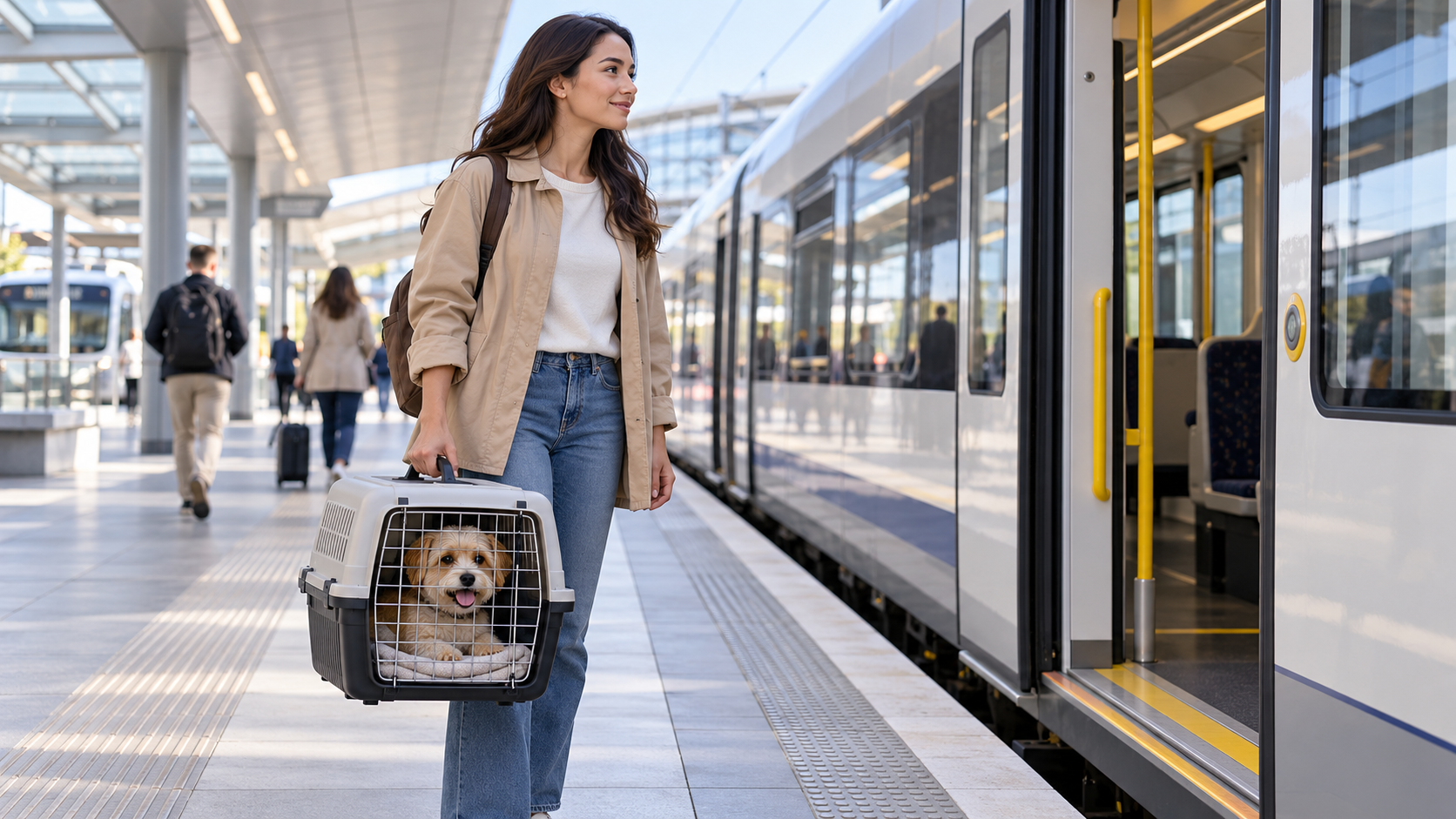
Quick answer: pets are allowed on some public transport, but the rules depend on the operator, mode, animal, size, equipment, time and available space. Small pets often need to stay inside a secure carrier. Larger dogs may require a short lead, muzzle, separate ticket or travel outside busy periods. Some services do not accept ordinary pets at all. Assistance animals follow different legal and operator rules.
Do not assume that permission on one vehicle covers the whole trip. A city train may accept a dog while the connecting coach does not, and a rail replacement bus may follow bus rules rather than rail rules. Check every operator before leaving and prepare a fallback that protects both the animal and other passengers.
Six checks before travelling with a pet
Find the current official conditions of carriage and answer these questions for each leg:
- Is the animal accepted? The policy may cover only dogs and cats, small domestic animals or particular species.
- Is a carrier required? Check maximum dimensions, closure and ventilation requirements.
- What applies to dogs outside carriers? Look for lead, muzzle, size and breed rules.
- Does the pet need a ticket? Free carriage, child fares, supplements and reservations all exist.
- Are there restrictions? Mode, carriage, station, busy period and capacity can change the answer.
- Which documents are required? Registration, vaccination, health or assistance-animal evidence may be requested.
Save the operator page offline. If the trip uses several companies, map every handoff with our step-by-step public transport planning guide.
Why pet rules vary by network and mode
Vehicles have different floor space, ventilation, evacuation routes and passenger loads. Operators also work under local transport, animal-control and accessibility laws. That creates large policy differences.
Transport for NSW, for example, prohibits ordinary pets on metro trains, trains and coaches but may allow a contained pet on buses, ferries and light rail with staff permission. Victoria permits small animals in suitable containers on metropolitan buses and trams, while trains also have conditions for dogs on leads and muzzles. Transport for Ireland publishes separate rules for each participating bus, tram and rail operator.
The lesson is simple: “pets allowed in this city” is not specific enough. Confirm the operator, vehicle type and exact service.
When a pet carrier is required
A secure carrier is the most widely accepted arrangement for small pets. It should be designed for the species, ventilated, clean, escape-resistant and large enough for the animal to remain in a safe natural position. The door and fasteners must stay closed throughout the journey.
Operator limits differ. Renfe specifies a maximum carrier size and weight for many small-pet journeys. Trenitalia publishes a different maximum size for small pets carried free. Denmark’s DSB uses its own dimensions, and New York’s MTA requires animals to be enclosed in a container and carried without annoying other passengers.
Measure the carrier at its widest points, including handles and wheels. Do not assume an airline-approved carrier automatically meets a railway or bus limit. Place an absorbent liner inside and keep the carrier on the floor, lap or designated luggage area as the operator directs—never on a seat unless expressly permitted.
Rules for dogs travelling outside a carrier
Some networks accept larger dogs without a carrier but impose tighter control requirements. Common conditions include:
- a short, non-retractable lead;
- a properly fitted muzzle;
- one dog per passenger;
- travel only in designated carriages or vehicle areas;
- a separate ticket or reduced fare;
- registration or vaccination documents; and
- exclusion during busy periods or when the vehicle is full.
Budapest’s BKK generally requires dogs outside a carrier to be muzzled and leashed and publishes dog-ticket rules. Zagreb’s ZET distinguishes small contained pets from larger dogs, which require a muzzle, short lead and specified documents. Rome’s ATAC permits dogs under particular mode and vehicle conditions and charges an ordinary ticket for most dogs.
Practice with the required equipment before travel. A muzzle must be the correct type and fit for the dog; do not improvise at the station. If you are unsure what is safe for your animal, ask a qualified veterinarian or trainer before the trip.
Assistance animals are not ordinary pets
Assistance animals often have separate access rights and conditions. Those rights are defined by local law and the operator’s policy, not by a general internet definition. Do not place a trained assistance animal in the pet category when checking a journey.
Transport for London permits assistance dogs across its core modes and also accepts other controlled dogs or inoffensive animals unless there is a valid reason to refuse them. Transport for NSW accepts assistance animals with recognized accreditation across public transport. Transport for Ireland permits guide and assistance dogs on all TFI services under its identification conditions.
Therapy animals, facility animals and emotional-support animals may not have the same public-access rights as trained assistance animals. Transport for NSW explicitly treats those categories as companion animals for its access policy. Verify the local definition, identification process and any advance permit requirement.
Check pet tickets and reservations
A passenger ticket does not always cover an animal. Policies include free small pets in carriers, a child fare for a larger dog, a fixed supplement, a full ordinary fare or a required reservation.
DSB carries smaller pets in qualifying carriers free but requires a child ticket for a larger dog. Trenitalia offers free carriage for small pets in qualifying carriers and a separate dog ticket for larger dogs under published conditions. Renfe’s fare and reservation rules vary by train category, pet weight and whether the animal travels in a carrier.
Buy the pet ticket before boarding when required and keep it with your own ticket. On a multi-operator route, a pet supplement from one company may not be valid on the next. Our guide to paying for public transport abroad explains how to check fare media and validation.
Build a pet-compatible route
The shortest route is not always the calmest or most reliable. Compare options using:
- fewer transfers and shorter station walks;
- working lifts instead of long escalators or crowded stairs;
- less busy travel times;
- outdoor waiting space where permitted;
- realistic toilet and water breaks before or after transit;
- temperature and ventilation conditions; and
- a backup if staff refuse carriage or capacity is full.
Keep transfer time generous. Moving a carrier through gates and finding the correct carriage can take longer than an ordinary connection. Use the train connection time guide and add a buffer appropriate to your animal and equipment.
If you also need step-free access or boarding assistance, follow our accessible public transport planning checklist and tell the operator about both the access requirement and animal when arranging help.
Prepare the animal before the first trip
Do not make a long, crowded journey the animal’s first experience of a carrier, lead, muzzle or station noise. Introduce required equipment gradually in a calm environment. A short off-peak practice ride may reveal problems without trapping you in a complex itinerary.
Before leaving:
- check that the carrier, lead and closures are undamaged;
- attach identification securely without displaying unnecessary personal details;
- carry waste bags, wipes and a small absorbent pad;
- bring water in a spill-resistant container for longer journeys;
- confirm any medication plan with the animal’s veterinarian; and
- avoid travelling if the animal is unwell, highly distressed or unsafe to control.
Do not give sedatives or other medication solely for travel without veterinary direction. The transport operator can explain its rules, but only an appropriate animal-health professional can advise on the individual animal.
Move safely through stops and stations
Keep the animal controlled before entering the transport area. Closed carriers should remain closed. A dog travelling outside a carrier should stay on the required lead and muzzle from the point specified by the operator.
Use wide gates when available and keep clear of platform edges, doors and crowds. TfL instructs passengers with animals to use stairs or lifts where provided; animals generally must be carried on moving escalators unless an applicable assistance-dog arrangement exists. Follow the local operator’s instructions rather than assuming the same practice everywhere.
Choose a waiting position with space between your pet and unfamiliar animals. Do not allow greetings between animals in a constrained platform or vehicle environment.
Board and ride considerately
- Let passengers exit before approaching the door.
- Keep the carrier level and close to your body.
- Move clear of the doorway without blocking an aisle or accessibility space.
- Keep the animal off seats and under control.
- Stay with the animal for the complete journey.
- Clean any mess promptly and follow staff instructions.
- Leave calmly before the animal becomes unmanageable.
Other passengers may have allergies, fears or assistance animals at work. Give them space. GO Transit asks passengers with dogs to avoid the accessibility coach where possible because service animals commonly use it. Never distract, pet or allow your animal to approach a working assistance animal.
Plan for busy or disrupted service
Permission may be discretionary when a vehicle is crowded. GO Transit allows leashed dogs outside rush hour under published conditions but requires carriers during rush hour. Other operators may simply let staff refuse an ordinary pet when capacity or safety demands it.
Check live alerts before departure. A replacement bus may prohibit an animal that the scheduled train accepts. If disruption changes the mode, recheck the pet policy rather than relying on the original ticket. Our disruption decision guide can help you compare waiting, rerouting and returning.
A useful fallback might be a later off-peak service, a direct route with fewer transfers, a verified pet-friendly taxi, or postponing the journey. Do not conceal an animal or argue your way onto a service that cannot carry it safely.
Local transit rules are not border-entry rules
Permission to board a bus or train does not satisfy animal import, quarantine or health requirements. International and cross-border journeys can require a microchip, vaccination records, health certificate, pet passport, approved route or advance reservation.
Check the government rules for every country and transit point, plus the carrier’s conditions. The local metro policy covers the ride to the station; it does not authorize the animal to cross a border.
Pet public transport checklist
- Every operator and mode checked separately
- Animal species, size and number permitted
- Carrier dimensions and closure confirmed
- Lead and muzzle rules checked
- Pet ticket or reservation purchased
- Required documents packed
- Off-peak route and realistic transfer time chosen
- Waste supplies, water and identification ready
- Live alerts and replacement-mode rules checked
- Safe fallback prepared
Frequently asked questions
Can dogs go on buses?
Sometimes. A network may require a carrier, permit leashed dogs at the driver’s discretion or prohibit ordinary pets. Check the exact bus operator and route.
Can cats travel on trains?
Many operators accept cats in a secure carrier that meets their size rules, but some services prohibit pets or require a pet ticket. The cat normally must remain inside the carrier.
Does a pet need a public transport ticket?
It depends. Small contained pets may travel free, while larger dogs can require a child fare, ordinary ticket, supplement or reservation.
Does my dog need a muzzle?
Some networks require muzzles for dogs outside carriers, sometimes regardless of size. Use the operator’s definition and a correctly fitted muzzle.
Is an emotional-support animal treated like an assistance animal?
Not necessarily. Legal definitions and access rights vary. Some operators classify emotional-support animals as ordinary companion animals unless they meet the local assistance-animal standard.
The practical takeaway
The reliable answer to “can you take pets on public transport?” is specific to the operator, vehicle and animal. Confirm acceptance, equipment, fare, documents, timing and capacity for every leg. Prepare the animal before travel, respect other passengers and keep a safe backup. Current staff instructions and local law always take priority over general advice.
Official sources and further reading
- Transport for NSW: travelling with animals and pets
- Transport Victoria: animals on public transport
- GO Transit: dogs travelling on GO
- Argentina government: pets on the Buenos Aires subway
- ZET Zagreb: transportation of animals
- ATAC Rome: animals on public transport
- Transport for Ireland: animals on TFI services
- BKK Budapest: dogs on public transport
- DSB Denmark: travel with pets
- Transport for London: conditions of carriage
- Trenitalia: travelling with your pet
- Renfe: travelling with pets
- New York MTA: rules of conduct for animals
- RATP Paris: travelling with an animal