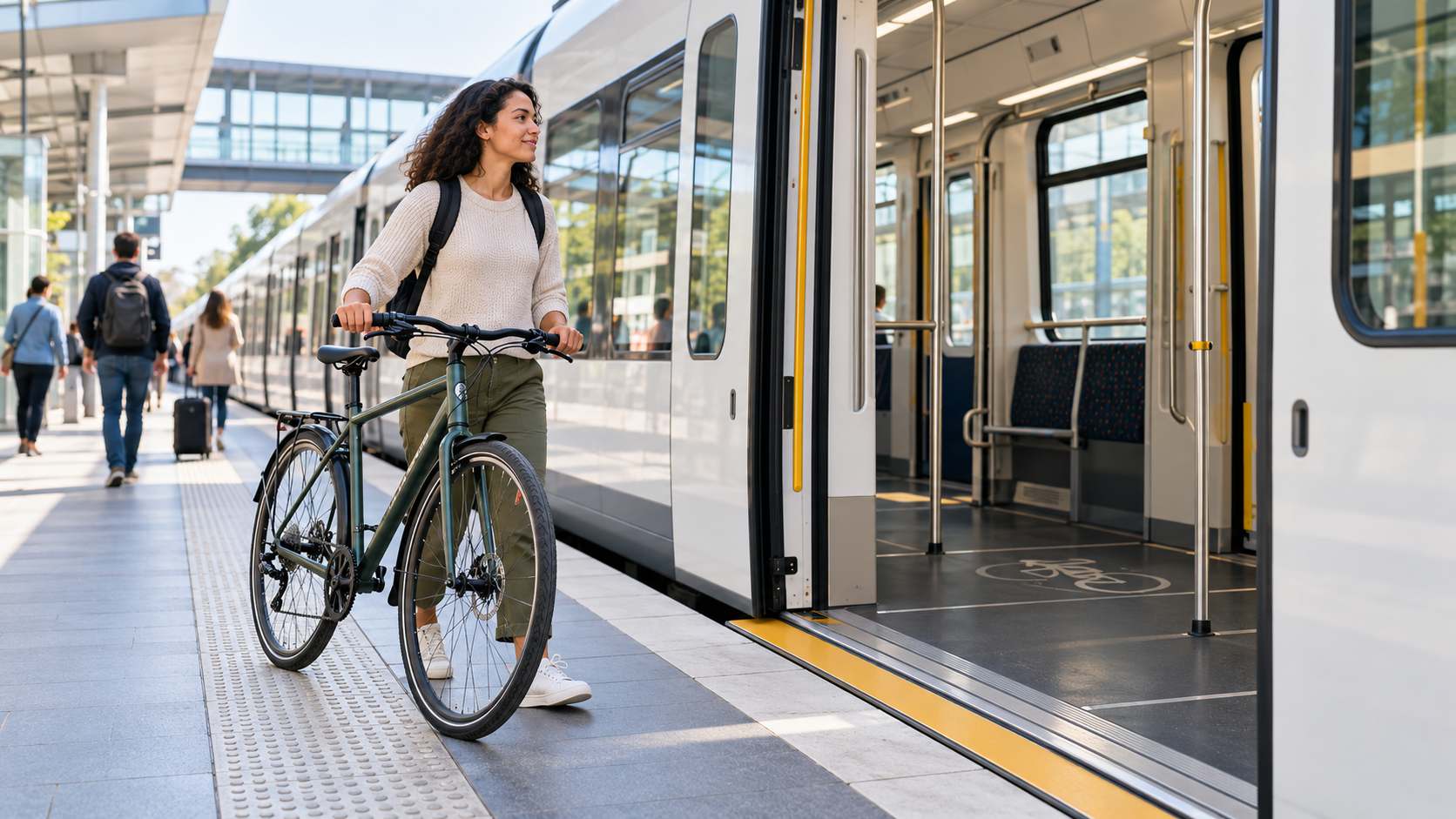
Quick answer: you can take a bike on some public transport, but permission depends on the operator, mode, time, bicycle type and available space. Full-size bikes are commonly accepted on selected trains, metros and ferries outside busy periods. Buses may require an external rack or prohibit them entirely. Folding bikes are often treated as luggage when fully folded, while e-bikes can face battery, weight and design restrictions.
Never assume that a bicycle symbol on one part of a network applies to the entire trip. A route can combine a bike-friendly train with a bus that will not take your bike. Check every operator’s current rules before leaving and keep a backup plan in case the designated space is full.
The five checks that answer the question
Before planning the route, find five pieces of information on the official operator website:
- Mode: Are bikes allowed on this train, metro, tram, bus or ferry?
- Time: Are there weekday peak-hour, event-day or station-specific restrictions?
- Bike type: Do the rules differ for full-size, folding, tandem, cargo or electric bikes?
- Fare or reservation: Does the bike need a ticket, reservation or checked-luggage booking?
- Capacity: Is carriage guaranteed, or only allowed when staff decide that space is available?
Write down the rule for each leg. Our step-by-step public transport planning guide can help you map the operators and transfers before adding the bike-specific checks.
Why bicycle rules vary so much
A bicycle occupies more floor space than ordinary luggage and is harder to move in a crowd. Operators balance bike access against evacuation routes, wheelchair priority, door clearance and passenger capacity. Vehicle design matters: a regional train may have reservable cycle spaces, while a city bus may have no safe place inside.
Policies can therefore differ even within one city. Barcelona’s TMB permits conventional bicycles on the metro during defined times but generally allows only fully folded bikes on buses. Transport for NSW allows bikes on metro and many train services when space is available but prohibits them on buses, including train-replacement buses. Rome’s ATAC applies different conditions across metro lines, buses and tram vehicle types.
These examples are not rules for the rest of the world. They show why the answer must come from the operator running the exact vehicle you intend to use.
Taking a bike on trains and metros
Urban and regional rail is often the easiest mode for a full-size bicycle, but “bikes allowed” may still include several conditions:
- travel only outside weekday peak hours;
- use a designated door, carriage or multipurpose area;
- buy a separate bicycle ticket;
- reserve a cycle space on intercity or regional services;
- avoid particular stations, platforms or line sections; and
- accept that staff can refuse boarding when crowded.
London’s official cycles-on-public-transport map distinguishes between folded and non-folding cycles, line sections and weekday restricted periods. Munich permits bikes on the U-Bahn, S-Bahn and selected regional trains outside its published rush-hour restrictions and requires a bike ticket in many cases. Copenhagen allows bikes free on S-trains but applies station and peak rules, while metro carriage normally requires a bike ticket and is restricted during rush hours.
Check the direction as well as the time. Some systems make directional exceptions during commuter peaks. Save the operator’s map or rule page offline, then confirm live service changes before you travel.
Taking a bike on a bus
Bus rules fall into three broad patterns:
- No full-size bikes: the vehicle has no safe storage area.
- External rack: the rider loads the bike onto a front or rear rack, usually without driver assistance.
- Inside carriage: selected large or low-floor vehicles accept a bike in a marked space when capacity allows.
Do not infer the rule from a photograph of another route. Sound Transit and TransLink in North America publish mode-specific instructions for bus racks and onboard carriage. GO Transit requires eligible non-folding bikes on its buses to use the front-mounted rack and publishes weight and e-bike battery conditions. In contrast, Adelaide Metro and Transport for NSW do not allow conventional bikes inside their regular buses.
If a rack is available, learn how it works before the bus arrives. Remove loose accessories, tell the driver before approaching the rack, secure the bike exactly as shown, and remind the driver before unloading. If the rack is full, your practical choices may be to wait, ride to another route or park the bike securely.
Are folding bikes treated differently?
Often. A fully folded bicycle may be treated as hand luggage and allowed at times when a full-size bike is prohibited. The word fully matters: operators can require the bike to remain folded throughout the station and journey, fit maximum dimensions, have dirty wheels covered or be carried in a bag.
Singapore’s Land Transport Authority permits foldable bicycles within its published size limit and requires them to stay folded on trains, buses and in stations. TMB allows fully folded bikes on the metro at any time when they do not inconvenience others and permits folded bikes on buses. Adelaide Metro specifies both a bag and maximum dimensions.
Measure the bicycle after folding, including handlebars, pedals and accessories. Keep protruding or oily parts covered. A folding bike does not give permission to block an aisle, doorway, seat or wheelchair area.
Check e-bike and battery rules separately
An e-bike may not be treated like a conventional bicycle. Operators can impose limits on weight, battery removal, battery condition, dimensions or motorbike-style designs. Converted bikes, damaged batteries, mopeds and fuel-powered cycles may be prohibited even where standard pedal-assist bicycles are accepted.
GO Transit, for example, publishes specific rules for permissible e-bikes, bus-rack weight and battery removal. Transport for NSW distinguishes converted e-bikes in its carriage policy. TransLink excludes motorbike-style e-bikes and seated electric mopeds. Always use the current definition supplied by the operator; marketing language used by a bicycle seller may not match the transit policy.
Before travel, check for swelling, impact damage, unusual heat or other battery problems. Do not charge a bike on the vehicle unless the operator explicitly provides and permits that service. Switch powered devices off when required.
Build a bike-compatible route
A valid bike-and-transit journey must work from the first station entrance to the final exit. Check:
- whether every vehicle accepts your bicycle;
- stairs, narrow gates and lift dimensions;
- the location of designated cycle doors or carriages;
- platform changes and transfer walking time;
- peak restrictions at the time you will actually transfer;
- the last service that still accepts bikes; and
- secure parking if one leg rejects the bike.
A route with one simple transfer may be better than the fastest itinerary through a crowded central station. Use our guide to reading public transport maps to confirm line directions, then apply the train connection time checklist with extra time for lifts and designated boarding areas.
Move safely through the station
Dismount before entering the station or interchange unless signs explicitly permit riding. Walk beside the bicycle, keep it under control and stay behind platform safety markings. Do not use the bike as a scooter, sit on it in a concourse or let it roll unattended.
Use lifts where the operator directs cyclists to do so. Athens transport authority OASA tells riders not to use station escalators with conventional bikes, and Metro Istanbul likewise prohibits bicycles on escalators. Even where an escalator is not expressly banned, a heavy bike can injure people if it slips. Choose the lift or stairs only when you can manage the bike safely and follow local signs.
Use a wide gate when available. Keep pedals, bags and handlebars clear of other passengers. At a busy platform, stand where the bicycle cannot roll toward the edge or obstruct the walking route.
Board, position and exit without blocking others
- Wait for passengers to exit before approaching the door.
- Use the door marked for bicycles or multipurpose space.
- Lift or roll the bike across the gap without riding it.
- Position it in the designated area and apply any provided restraint.
- Stay with the bike and prevent it from moving.
- Keep doors, aisles, seats, emergency equipment and exits clear.
- Prepare to leave early enough to avoid a last-second rush.
Wheelchair users and other passengers with priority needs may have first claim on a shared space. Adelaide Metro explicitly requires bikes to move from a wheelchair space when a mobility-aid user needs it; other networks use similar priority rules. Cooperate with staff and be ready to use another carriage or service.
What to do when the bike space is full
Bike access is frequently capacity-dependent. Sound Transit states that bicycles are not accepted onboard during defined crowded conditions, while several other operators leave the decision to staff. A timetable showing the service does not guarantee space for the bike.
Plan a fallback before departure:
- wait for the next eligible service;
- ride to a less crowded station or parallel line;
- fold the bike if it is designed to fold and the rules permit it;
- use secure station parking and continue without the bike; or
- travel outside the restricted period.
If an unexpected closure introduces a replacement bus, recheck the bike policy immediately. A rail ticket does not guarantee that the replacement vehicle can carry a bicycle. The decision framework in our public transport disruption guide can help you compare waiting and rerouting.
Confirm tickets, reservations and liability
Some networks carry bikes free; others require a bicycle ticket, a reservation or a checked-luggage fee. The rider’s passenger ticket may not cover the bike. Long-distance trains can sell out of cycle reservations even when passenger seats remain available.
Check whether the bicycle ticket is valid across operators and whether you must validate it separately. Keep the booking available offline. If the fare system is unfamiliar, see how to pay for public transport abroad.
You are normally responsible for controlling the bike, loading it where required and preventing damage. Remove valuables and loose accessories. Never lock the bicycle to a train fitting unless the operator specifically instructs you to do so.
Do not treat bike access as accessibility access
A bicycle and a mobility device are not interchangeable under transit rules. Do not use an accessibility designation to bypass a bicycle restriction. Shared spaces, lifts and wide gates must remain available to passengers who need them.
If a disability means you use a cycle as a mobility aid, contact the operator about its specific accommodation process rather than relying on the standard bike page. Our accessible public transport guide explains how to document dimensions, assistance and backup arrangements.
Bike-and-transit checklist
- Every operator and mode checked separately
- Full-size, folding or e-bike category confirmed
- Peak, event and station restrictions checked
- Bike fare or reservation purchased if required
- Designated door, carriage or bus rack identified
- Lift access and transfer time verified
- Loose accessories removed or secured
- Backup prepared for a full space or replacement bus
- Live alerts checked before departure
Frequently asked questions
Can I take a bicycle on a train?
Often, but the operator may restrict full-size bikes by time, line, station or available capacity. Regional and intercity trains may also require a bike ticket or reservation.
Can I take a bicycle on a bus?
It depends on the fleet. Some buses have external racks, some accept only folded bikes, and others prohibit bikes entirely. Check the exact operator and route.
Do I need a separate ticket for my bike?
Sometimes. Bike carriage may be free, included off-peak, charged as a separate fare or available only with a reservation. Verify each operator on a multi-operator trip.
Can I take a bike during rush hour?
Many networks restrict full-size bikes during weekday peaks, but the hours and affected directions vary. Folding bikes may have different rules when fully folded.
Can I take an e-bike on a train?
Possibly, but check the operator’s definition, weight, battery, design and time restrictions. Damaged, modified or motorbike-style devices may be prohibited.
The practical takeaway
The safest answer to “can you take a bike on public transport?” is a route-specific one. Verify the mode, time, bike type, fare and capacity for every leg. Then plan how you will enter, transfer, board and respond if the space is full. Current operator instructions and staff decisions always take priority over general guidance.
Official sources and further reading
- Transport for NSW: travelling with bikes and surfboards
- TMB Barcelona: rules for travelling with bicycles
- OASA Athens: travelling with bicycles
- Sound Transit: bikes and scooters on transit
- Adelaide Metro: taking bikes on board
- City of Munich: taking a bike on public transport
- GO Transit: biking and transit
- ATAC Rome: bicycles on vehicles
- City of Copenhagen: bikes on metro, train and harbour bus
- Metro Istanbul: bicycle travel rules
- TransLink Vancouver: bikes on transit
- Transport for London: cycles on public transport map
- Singapore LTA: foldable bicycles on public transport