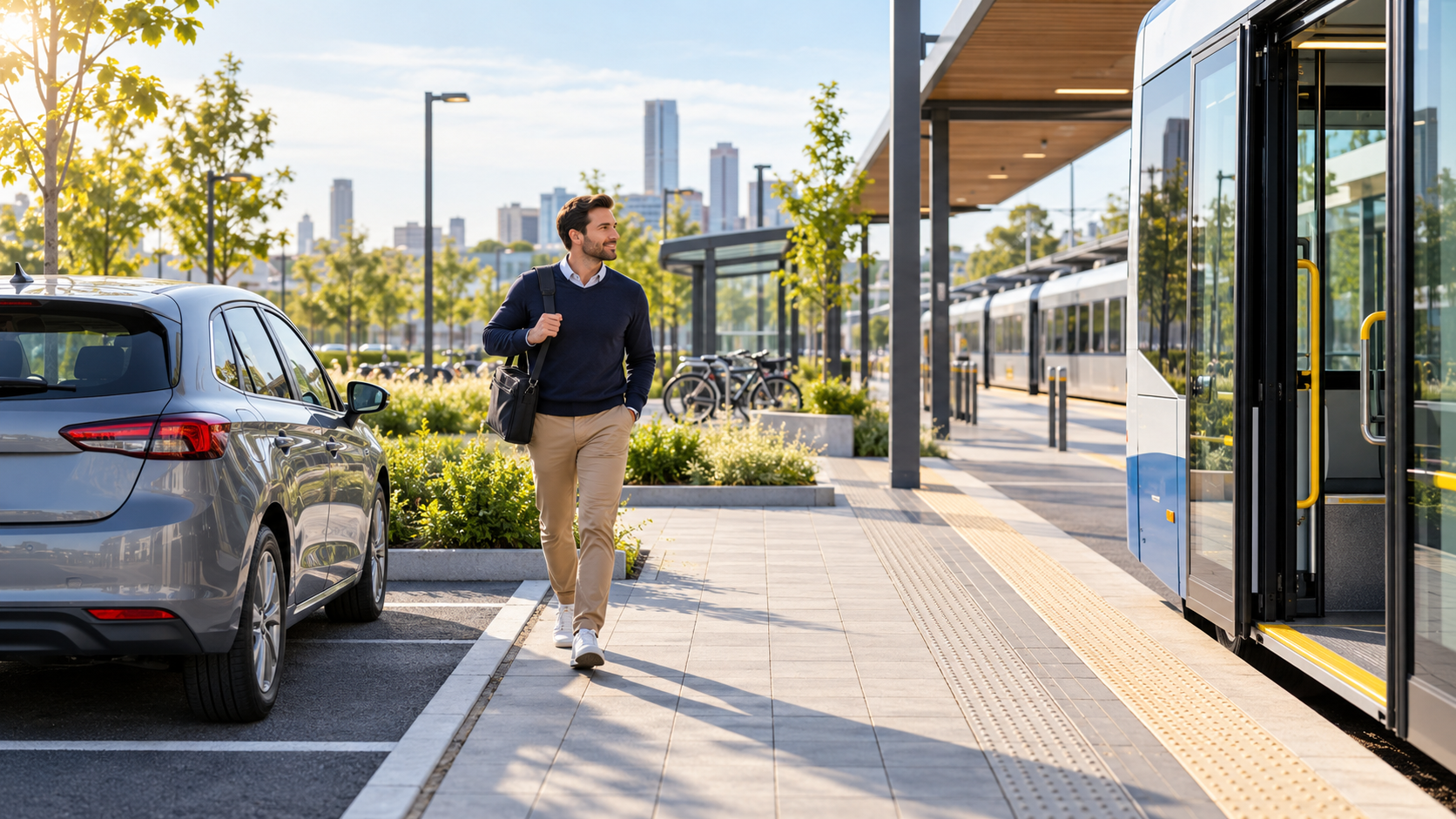
Quick answer: park and ride lets you leave a car at a designated facility and complete the journey by bus, train, metro, ferry, carpool or another approved mode. You normally park, record or validate the vehicle or parking ticket, take the connecting service, then return before the car park or transit service closes. Parking may be free, paid, bundled with transit or discounted only when the system verifies an eligible trip.
The important detail is that park-and-ride schemes are not standardized. One site may be an open first-come lot; another may require an account, license-plate registration, transit tap or validated return ticket. Always check the exact facility, operator and travel date before driving there.
What is park and ride?
A park-and-ride facility is a transfer point between a private vehicle and a shared transport mode. It is usually located outside a congested center or beside a major station. The goal is to make the long or difficult part of a trip by transit while keeping a car out of the busiest area.
Virginia’s Department of Transportation describes park-and-ride lots as places where travelers can park a car or bicycle and continue by transit, carpool, vanpool or bike. City-specific schemes may be narrower: Coventry’s service, for example, is designed around parking and finishing the journey by bus.
Park and ride is different from ordinary station parking when a special price or eligibility rule depends on taking public transport. It is also different from “kiss and ride,” where a driver stops briefly to drop off or collect someone without parking for the trip.
1. Choose the lot by the onward route, not only distance
The nearest car park is not automatically the best one. Start from the destination and work backward:
- find the transit lines that reach your destination;
- identify park-and-ride sites served by those lines;
- compare frequency, transfer count and last return service;
- check road access and expected parking availability; and
- choose a backup lot on another useful line.
A farther lot with a frequent direct train can be more reliable than a closer lot with an infrequent bus and transfer. Use our step-by-step public transport planning guide to map the transit portion before committing to the drive.
2. Confirm who may use the facility
Some lots are open to any transit passenger. Others are reserved for commuters, registered permit holders, carpool users or customers completing a qualifying trip. Check:
- whether public transport use is mandatory;
- whether the vehicle plate must be registered;
- whether a permit, account or local-resident status is required;
- whether motorcycles, vans, trailers or motorhomes are accepted;
- whether rental or shared cars can be linked; and
- whether accessible bays require a valid permit.
Transport Canberra requires a digital permit at some locations and links the vehicle, payment method and completed bus or light-rail trip through one account. RTD Denver calculates some parking fees based on whether the vehicle is registered inside its service district. These examples show why the same-looking car park can have very different eligibility rules.
3. Check both parking hours and transit hours
A car park can remain open after its dedicated shuttle has stopped—or close while other transport is still running. Record four times:
- earliest car park entry;
- first useful departure;
- last service back to the car park; and
- latest permitted car park exit.
Winchester’s park-and-ride parking is available every day, but its dedicated bus does not operate on some days. Derby lists a car park closing time that can be earlier than a traveler expects. Never infer the last return from the car park gate hours.
For evening plans, work backward from the last service that reaches the correct lot. Our late-night transit guide explains how to protect the final connection.
4. Understand what the quoted price includes
Park-and-ride pricing usually follows one of four models:
- parking is free and the transit fare is separate;
- parking is paid and transit is separate;
- one ticket covers parking and transit for a defined number of passengers; or
- the normal parking price is reduced after a qualifying transit journey.
Coventry charges for parking in addition to the bus fare and provides a discount parking ticket through the bus. Canterbury sells a per-car day ticket that includes travel for a defined passenger group. Amsterdam applies a lower parking rate only when specific travel and validation conditions are satisfied.
Read the inclusions before paying. “Park and ride from €5” may refer only to parking, only to the bus or a restricted arrival period. If payment methods are unfamiliar, use our public transport payment guide.
5. Follow the validation sequence exactly
Discounted systems often match parking with an eligible transit trip. The sequence can matter:
- enter through the correct park-and-ride lane;
- keep the parking ticket or confirm the plate was captured;
- use an accepted fare card or ticket for the transit journey;
- complete required taps, check-ins and check-outs;
- return within the stated time window;
- scan or validate the transit credential at the parking machine; and
- pay and exit before the validation expires.
Transport for NSW grants eligible parking after a completed transit trip with an accepted card and a defined exit window. Amsterdam requires the return trip and final check-in or transfer to meet geographic and timing conditions, then the traveler must scan an accepted credential at payment. Hong Kong’s Transport Department publishes precise card, station and timing rules for its concession.
Using the wrong bank card, phone wallet, paper ticket or entrance lane can cause the full parking rate to apply. Take a screenshot of the current instructions before entering.
6. Plan for first-come capacity
Many lots do not guarantee a space. Metlink in Wellington states that its park-and-ride spaces are first-come, cannot be reserved and can fill early. Transport Canberra uses the same first-come principle at its sites, while Transport for NSW publishes live availability for many facilities.
If the trip has a fixed appointment, check typical peak occupancy and arrive with enough time to use the backup lot. Do not circle until the transit departure becomes a last-minute rush. A parking space is only useful if you can still reach the platform safely.
7. Read the signs at the exact bay
Online guidance is only part of the rule set. At the site, check entrance signs, bay markings and payment-machine instructions for:
- reserved, permit, carpool and accessible spaces;
- maximum stay and overnight rules;
- height, length or vehicle-type limits;
- charging-bay time limits;
- event-day restrictions;
- tow-away areas and closing gates; and
- the correct zone or facility number for mobile payment.
VDOT notes that many, but not all, lots are free and that overnight permission depends on the facility. Metlink prohibits overnight parking at its sites, while RTD Denver permits longer stays under defined payment rules. The local sign controls.
8. Make the return trip easy to recognize
Large interchanges may have several parking areas and outbound platforms. Before leaving the vehicle:
- save the exact facility name and street entrance;
- photograph the level, row or nearby landmark without capturing other people’s personal details;
- pin the car location offline;
- note the return route number and destination shown on the vehicle; and
- identify the correct stop in the city for the trip back.
“Take the bus back to park and ride” is not enough if several sites use similar services. Read the vehicle destination, and ask the driver when uncertain. Our guide to reading transit maps and directions helps distinguish branches and termini.
9. Treat the lot like any public parking area
Lock the vehicle, close windows and remove valuables from view. Do not leave travel documents, spare keys or visible bags inside. Use the designated pedestrian path and remain aware of moving vehicles.
CCTV, lighting or patrols do not guarantee against theft or damage. RTD says vehicles are parked at the user’s risk, and other operators publish similar limitations. For broader stop, station and onboard habits, see how to stay safe on public transport.
10. Check accessibility across both halves
An accessible parking bay does not prove that the path, platform and vehicle are accessible. Verify the bay, curb cuts, lift or ramp, boarding process, wheelchair space and destination stop.
Canterbury describes kneeling buses or front ramps at its park-and-ride stops, but equipment and boarding rules vary. If you need assistance, confirm it for the exact service and time. Our accessible public transport checklist covers the complete route.
11. Check EV, bicycle and carpool options separately
Some park-and-ride sites include EV charging, bicycle lockers or preferred carpool bays. Each has separate conditions. A charging bay may require active charging and impose a time limit. A bicycle locker may require registration or rental. A carpool bay may require a minimum number of occupants who all continue by transit.
VDOT describes park-and-ride as supporting transit, carpools and vanpools. Metlink publishes separate carpool parking conditions. If you combine cycling with the transit leg, check our bike-on-public-transport planning guide.
12. Recheck event days and disruptions
Sporting events, holidays, construction and service changes can alter parking access, fares, shuttle frequency or the last return. A lot may be reserved for event use, or the connecting line may use replacement buses from another location.
Check both the parking operator and transit operator on the day. If the trip changes, confirm that the replacement service returns to the same facility. Use our disruption decision guide to compare waiting, rerouting and moving to a backup lot.
What if you miss the last service back?
First, confirm that the service has not moved to another stop or platform. Ask staff and check official alerts. If service has ended, use a safe, verified backup—such as a licensed taxi, booked ride, trusted pickup or permitted overnight option.
Do not walk along restricted roads, tracks or busways to reach the car. Check whether the car park will close or charge an overnight rate, and contact the facility operator if required. Safety is more important than avoiding an extra parking charge.
Park-and-ride checklist
- Onward route and destination verified
- Backup lot selected
- Eligibility and vehicle registration checked
- Parking and transit opening hours recorded
- Last return service protected
- Parking price and transit fare separated
- Validation sequence saved
- Capacity or live availability checked
- Maximum stay and overnight rule confirmed
- Exact car location and return route saved
Frequently asked questions
Is park and ride free?
Sometimes. Parking may be free, paid, included with transit or discounted only after a qualifying trip. Check parking and transit charges separately.
Do I need a park-and-ride ticket?
It depends. Some sites require only a normal transit ticket; others use a parking ticket, permit, linked account, license plate or special combined ticket.
Can I leave my car overnight?
Only where the facility permits it. Overnight rules vary by lot and may require notice, payment or a maximum stay. Posted signs take priority.
What happens if the car park is full?
Use the planned backup lot or another transport option. Do not park in reserved, accessible, staff-only or unmarked areas.
How does the car park know I used public transport?
Systems may match a fare-card tap, scan a return ticket, link a transit account to the vehicle plate or issue validation onboard. Follow the local sequence exactly.
The practical takeaway
Park and ride is a two-part trip with a parking rule and a transit rule. Choose the site by the onward service, confirm eligibility and hours, understand what the price includes, follow the validation sequence and protect the last trip back. When those pieces line up, park and ride can turn a difficult drive into a simpler transit journey.
Official sources and further reading
- City of Amsterdam: how P+R works
- Transport for NSW: Transport Park&Ride
- Transport Canberra: park and ride
- Virginia DOT: park and ride
- Hong Kong Transport Department: park-and-ride conditions
- RTD Denver: park-n-ride parking
- Fairfax County Connector: park-and-ride FAQ
- Minnesota Valley Transit Authority: park-and-ride facilities
- Metlink Wellington: park and ride
- Coventry City Council: park and ride
- Winchester City Council: park and ride
- Canterbury City Council: park and ride