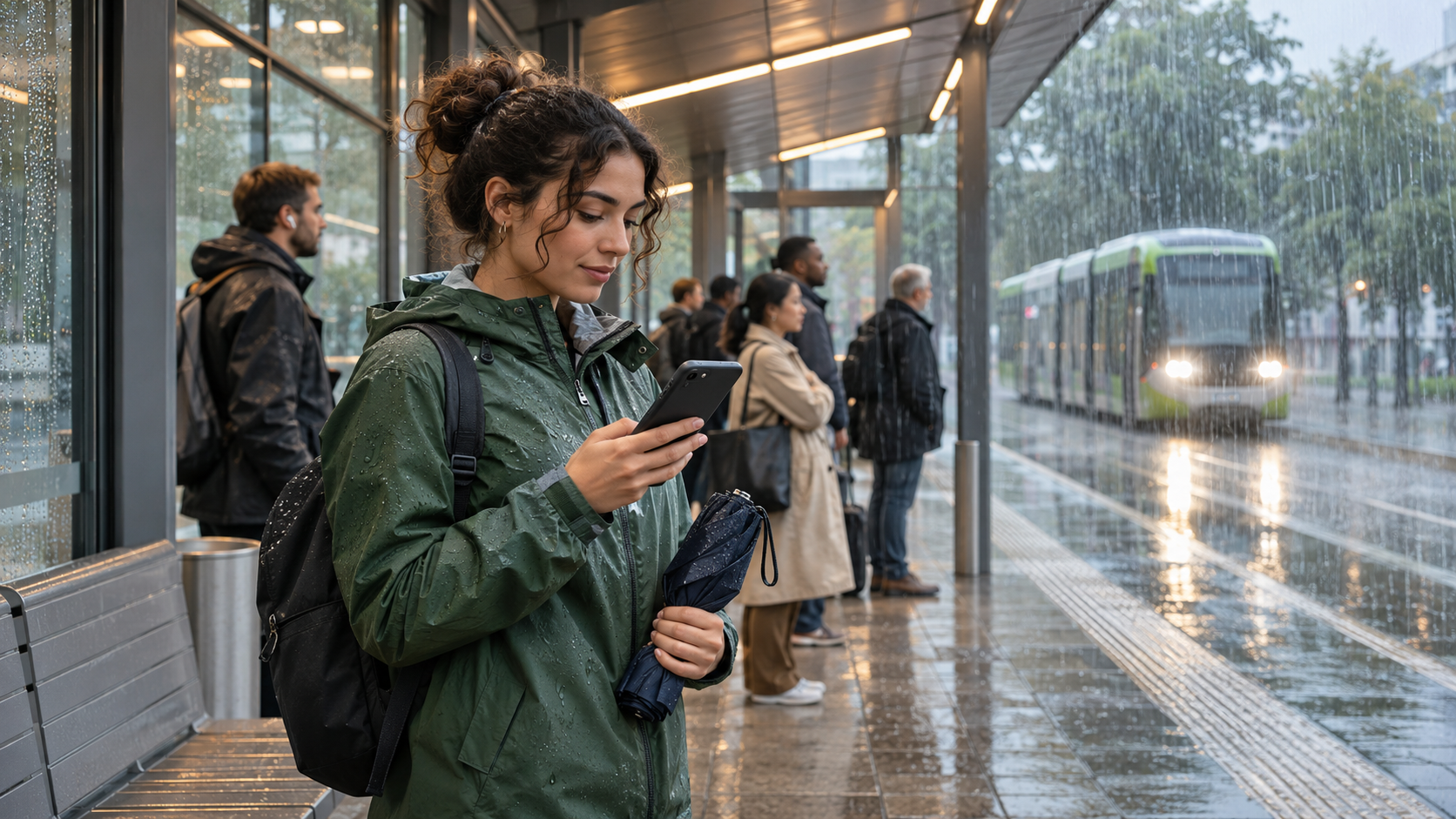
Quick answer: to use public transport in bad weather, check both the official weather warning and the transit operator's live service status before leaving. Allow extra time, protect the final connection, save a backup route, dress for outdoor waits, keep your phone charged and never cross floodwater, tracks or a road to reach a stop. If authorities advise against travel or the route is unsafe, delay the trip.
Bad weather changes more than vehicle arrival times. It can close entrances, stop ferries, divert buses, slow trains, disable lifts and make the walking sections of a journey hazardous. Plan the entire door-to-door trip—not just the time spent on board.
First decide whether the trip should happen
Read the warning for the exact place and time of travel. A color or category alone is not enough: the detailed notice explains the expected impacts, likelihood, affected area and recommended action. The Met Office, for example, distinguishes warnings that may disrupt some journeys from dangerous conditions in which people should avoid travel where possible.
Then check the transport operator. A network may keep underground rail running while suspending exposed sections, buses or ferries. Hong Kong's MTR adjusts different modes and open railway sections according to tropical-cyclone signals and can suspend service without notice if conditions deteriorate. WMATA similarly states that severe winter weather can limit or stop service for safety.
Delay or cancel when official authorities advise it, the walking route is flooded or icy beyond safe use, the return service is uncertain, or the trip is not essential and conditions are worsening. Transport for NSW explicitly advises checking the forecast and reconsidering travel when conditions are poor.
1. Check two live sources before leaving
Use two separate sources:
- the official weather authority for warnings, timing and geographic impact; and
- the official transit operator for cancellations, diversions, station access and replacement services.
A general map app may lag behind an operational change. Open the alert itself and confirm the affected direction, stops, time window and mode. Auckland Transport warns that services may change at short notice because of weather and shows detours, cancellations and alternative stops in its official tools. Network Rail advises passengers to check train-operator channels during storms and flooding.
Take a screenshot of the latest plan, but refresh before each transfer. Our guide to scheduled versus real-time transit arrivals explains why a timetable entry can remain visible after the operating plan changes.
2. Inspect the whole door-to-door route
Break the journey into:
- walk or roll to the first stop;
- waiting environment;
- each vehicle;
- every interchange;
- final walk; and
- return journey.
Look for low underpasses, exposed bridges, steep slopes, unpaved paths, ferry wharves, outdoor platforms and crossings that may be unsafe in rain, wind, ice or extreme heat. A rail line may be running while the only accessible entrance is closed. A bus diversion may use a temporary stop several blocks away.
Use our step-by-step trip-planning guide to verify directions and stops, then review the weather exposure on every walking link.
3. Add a weather-specific time buffer
Allow time for slower walking, longer waits, reduced frequencies, road congestion and controlled boarding. Do not use the normal journey estimate for a time-critical appointment. Severe weather can make trains run under speed restrictions or on a reduced timetable; hot weather can also trigger railway speed restrictions as tracks and equipment respond to heat.
Build the buffer backward from the last useful connection. If missing one bus causes a 40-minute wait outdoors, protect that leg more aggressively than a frequent metro. For rail connections, see how much time to leave between trains.
Weather can worsen after departure, so plan the return as carefully as the outbound trip. Check when the warning is expected to peak and whether the last service may change.
4. Save a genuinely independent backup
A useful backup does not depend on the same vulnerable infrastructure. A second bus route using the same flooded road is not independent. Consider:
- a more sheltered rail route instead of an exposed ferry;
- a frequent main-road bus instead of a low-lying local route;
- a station with step-free access if lifts at the first choice are unavailable;
- leaving earlier or later; or
- postponing the journey.
Do not assume a taxi or ride-hail vehicle will be available during a regional storm; demand and road closures affect those services too. Save operator contact details and the address of a safe indoor waiting place near important interchanges.
5. Carry a small weather travel kit
Choose items for the forecast and the amount of outdoor exposure:
- charged phone and compact power bank;
- water-resistant outer layer;
- closed, slip-resistant footwear;
- water in hot weather;
- warm layer, gloves and hat in cold weather;
- small torch or phone light for outages;
- essential medicine;
- waterproof pouch for documents and electronics; and
- a compact umbrella only where wind and space make it safe.
Keep everything manageable in one movement on and off the vehicle. Large wet umbrellas and loose bags can block aisles. Our public transport luggage guide covers safe storage and transfers.
Heavy rain and flooding
Slow down on wet stairs, ramps, platforms and vehicle floors. Use handrails and leave more space around other passengers. TransLink warns that water carried in on umbrellas and clothing can make surfaces slippery, while Transport for NSW highlights increased risks of slips and falls in wet conditions.
Never enter floodwater to reach a stop, station or replacement bus. Water can hide open drains, sharp debris, unstable ground and electrical hazards. The Met Office advises pedestrians to avoid floodwater, including apparently shallow moving water. Use an official alternative or wait in a safe place.
Expect buses to stop somewhere safer than the usual curb when drainage, snow or debris blocks access. Stay on the sidewalk and follow the driver's or staff member's direction. Do not stand in the road to flag a vehicle.
Snow, ice and extreme cold
Travel only when necessary if the operator warns of hazardous conditions. WMATA tells riders to expect delays and increased wait times, dress for longer outdoor exposure, stay on the sidewalk when snow blocks a curb and never run for a vehicle.
Use cleared, well-lit paths and take short steps on ice. Keep hands available for rails rather than carrying too many items. Do not walk along tracks, bus lanes or roads because a normal footpath is blocked.
Service patterns can contract as conditions worsen. Rail systems may suspend exposed sections while continuing some underground service, and buses may use snow routes. Confirm that the destination and return route still operate before boarding.
Extreme heat
High temperatures affect both riders and infrastructure. Transport for NSW warns that heat can require train speed restrictions and recommends avoiding the hottest part of the day, carrying water, waiting out of direct sun and checking alerts. LA Metro advises bringing water, using shade and reducing outdoor waiting during peak sun.
Choose routes with shorter outdoor waits, shaded stops and staffed stations. Do not rely on a shelter having water or cooling. If you feel unwell before boarding, seek help at the stop or station rather than entering a vehicle where assistance may be harder to reach.
Heat risk varies by person. Children, older adults, pregnant travelers, people with disabilities and those taking certain medicines may need a more conservative plan. Follow local health guidance and do not treat an article or journey planner as medical advice.
High winds, thunderstorms and tropical cyclones
Strong wind can bring down trees, damage overhead wires, move debris and make exposed platforms, bridges and ferry facilities unsafe. Network Rail explains that debris and fallen trees can block tracks and damage power equipment. Lightning and wind can also interrupt electrical and signaling systems.
Avoid exposed walking routes and do not shelter under damaged trees, unstable structures or loose signs. Close umbrellas before reaching crowded platforms or strong gusts. Follow local emergency instructions.
In tropical-cyclone areas, learn the meaning of local warning signals. MTR's typhoon guidance shows that service can change by signal level, mode and whether the railway is above or below ground. Do not assume yesterday's storm procedure applies; check the current official notice.
Fog, darkness and low visibility
Heavy rain, snow and fog make it harder for drivers and riders to see each other. Wait at the marked stop, in a lit place, without stepping into traffic. Wear a visible outer layer or reflective accessory when practical. Keep the phone ready but look up frequently.
If a bus cannot safely reach the regular stop, it may stop nearby. Make eye contact with the driver where possible and follow instructions. At an unfamiliar temporary stop, confirm the route number and destination before boarding.
Move safely through stations and stops
- Walk—never run—on wet or icy surfaces.
- Use lifts for prams, mobility devices, bicycles and heavy luggage where required.
- Stand behind platform markings.
- Let passengers exit before boarding.
- Keep doorways, drains and sheltered waiting areas clear.
- Report a spill, ice patch, fallen branch or damaged shelter to staff.
If a vehicle is full because many travelers changed modes, wait for the next safe option rather than pushing aboard. The techniques in our rush-hour public transport guide also apply to weather-driven crowding.
Bad-weather planning with accessibility needs
Weather can remove an otherwise accessible link: a lift may fail, a curb ramp may be blocked by snow, a temporary bus stop may lack a safe boarding area or paratransit may change from door-to-door to curb-to-curb operation.
Check accessibility alerts and contact the operator before leaving. Confirm:
- step-free entrances and lift status;
- the exact location of any replacement stop;
- boarding assistance and staffing;
- whether booked assistance remains valid; and
- a safe indoor place if the connection is delayed.
Use our accessible journey checklist to verify each leg. If the safe accessible path is unavailable, ask the operator for an alternative rather than improvising across unsafe terrain.
Traveling with children or a group
Hold children's hands near roads, platforms and floodwater. Keep the group together and agree on a meeting point before entering a busy station. Dress each person for a longer wait, not only the planned vehicle time.
A large group may need to split across vehicles. Give every adult the full itinerary, backup and destination. Our guide to using public transport with children covers boarding, prams and separation plans.
If the weather disrupts the trip after departure
- Stay in a safe, staffed or sheltered location.
- Read the operator's full alert, not only the notification headline.
- Listen to staff and onboard announcements.
- Confirm the final connection before accepting a reroute.
- Keep the original ticket, screenshots and delay evidence.
- Do not leave a safe station for an unverified replacement stop.
Replacement transport may take time to organize and may not look like the normal service. Follow official directions. Our public transport disruption plan helps compare waiting, rerouting and ending the trip.
Bad-weather public transport checklist
- Official weather warning read in full
- Transit status checked before departure
- Every outdoor and transfer segment reviewed
- Extra time and final connection protected
- Independent backup route saved
- Return journey checked
- Phone charged and operator contacts saved
- Clothing and footwear matched to conditions
- Water, medicine and essentials packed
- Accessibility changes verified
- Floodwater, tracks and unsafe roads avoided
- Plan ready to delay or cancel if conditions worsen
Frequently asked questions
Does public transport run in severe weather?
Often with changes, but it depends on the mode, infrastructure and local warning. Service may be delayed, diverted, reduced or suspended, sometimes with different rules for exposed and underground sections.
How much extra time should I allow?
Allow for slower walking, longer waits and at least one missed connection when the trip is important. Increase the buffer when service is infrequent or the final connection has no replacement.
Is a train always safer than a bus in bad weather?
No. The safest and most reliable mode depends on the specific hazard and route. Flooding, heat, wind, snow and electrical problems affect modes differently; use current official advice.
Should I walk through shallow floodwater to reach a stop?
No. Floodwater can conceal current, debris, open drains and electrical hazards. Turn back and use a verified alternative or wait in a safe place.
What should I do if my last service is cancelled?
Stay somewhere safe, read the operator's alert, ask staff about official replacement transport and keep evidence of the disruption. Do not walk an unsafe route or accept an unverified ride.
The practical takeaway
Using public transport in bad weather is a go-or-no-go decision before it is a routing problem. Read the official warning, confirm live service, inspect every outdoor link and protect the return journey. Carry a small weather kit, allow more time and use verified alternatives. When the route crosses floodwater, exposed infrastructure or conditions authorities call unsafe, the correct plan is to delay the trip.
Official sources and further reading
- Transport for NSW: safety and poor-weather travel
- Transport for NSW: hot-weather train restrictions
- TransLink Metro Vancouver: safety and winter travel
- WMATA: severe-weather service and winter tips
- Los Angeles Metro: extreme-heat safety
- Hong Kong MTR: travel during typhoons
- Auckland Transport: check before traveling
- Met Office: weather warnings guide
- Met Office: severe weather and rail travel
- Network Rail: responding to weather impacts
- Network Rail: storms and flooding